

Data protection and resilience are non-negotiable objectives for any modern organizations, as data itself is no longer a byproduct of operations—it is the business. Whether we’re discussing financial services, manufacturing, retail, or critical infrastructure, the ability to protect, recover, and continuously access data defines operational resilience and competitive advantage.
Industry research consistently reinforces this. According to Gartner, downtime costs for large enterprises can exceed thousands of dollars per minute, while IBM reports in its Cost of a Data Breach studies that business disruption is one of the most significant contributors to total breach cost. Meanwhile, Uptime Institute highlights that over 60% of outages result in losses exceeding $100,000.
Core business objectives for data protection
Against this backdrop, organizations must align their data protection strategy with a set of core business objectives:
- Operational continuity
Systems must remain available—or be restored quickly enough to avoid operational paralysis. This applies equally to customer-facing platforms and internal systems such as ERP or supply chain management. - Data integrity and availability
It’s not enough to “have data somewhere.” Businesses require assurance that data is accurate, consistent, and accessible when needed. - Regulatory compliance
Frameworks like GDPR, DORA, NIS2, and industry-specific mandates require strict controls over data retention, recoverability, and resilience testing. - Cyber resilience
Ransomware has fundamentally changed the conversation. Data protection strategies must assume breach scenarios and ensure rapid recovery without paying attackers. - Scalability and cost efficiency
Data volumes are growing exponentially. Solutions must scale without introducing unsustainable cost structures or operational complexity.
This is where the distinction between Backup, Disaster Recovery (DR), and Disaster Recovery as a Service (DRaaS) becomes critical. These are not interchangeable concepts—they represent different maturity levels of resilience.
Starting small: Backup remains foundational
Backup is often perceived as a basic or even “solved” problem. In reality, it remains the cornerstone of any data protection strategy, even in advanced cloud-native environments.
What is backup?
At its core, backup is the process of creating copies of data that can be restored in case of loss, corruption, or compromise. It is fundamentally about data preservation, not service continuity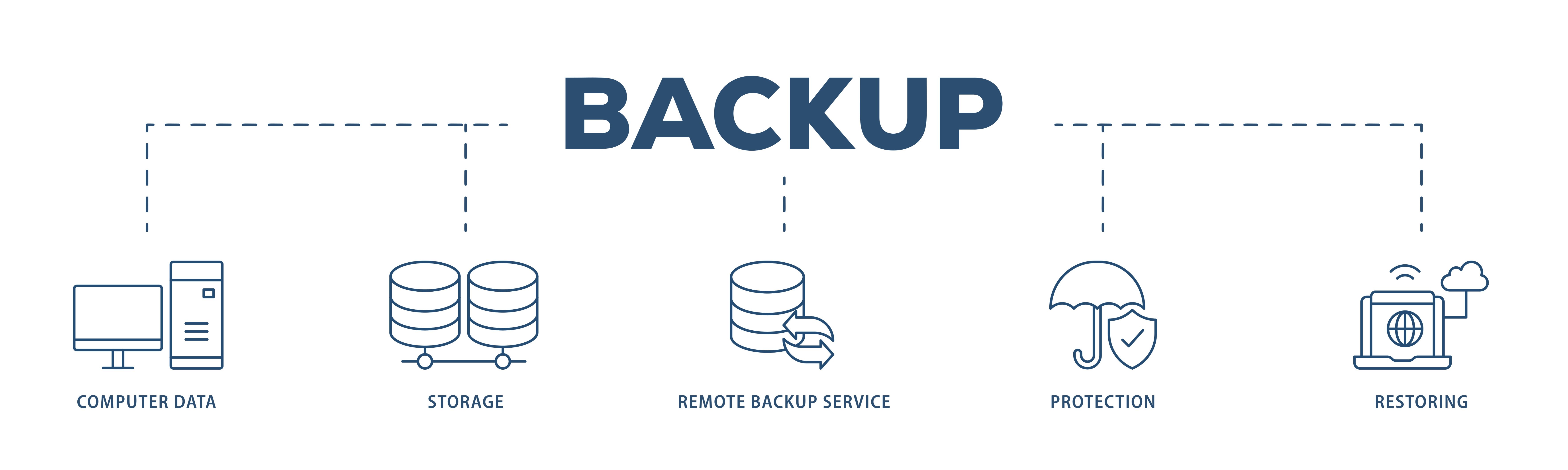
Top KPIs for backup
From a business perspective, backup effectiveness is measured through:
- RPO (Recovery Point Objective) – how much data loss is acceptable (e.g., 1 hour, 24 hours)
- Backup success rate – percentage of successful backup jobs
- Backup window – time required to complete backups
- Restore success rate – arguably more important than backup itself
- Data retention compliance – alignment with regulatory requirements
Types of backup
Organizations typically implement a combination of:
- Full backup – complete copy of all data; resource-intensive but simple to restore
- Incremental backup – captures only changes since the last backup; efficient but complex recovery chains
- Differential backup – changes since last full backup; balances speed and complexity
- Immutable backups – cannot be altered or deleted, critical for ransomware defense
- Snapshot-based backups – fast, storage-level copies, widely used in virtualized and cloud environments
Solutions from providers like M247 Global emphasize hybrid backup strategies combining on-premise and cloud storage to ensure both performance and resilience
The golden rules of backup
Across industry best practices, a few principles consistently emerge:
- 3-2-1 rule: 3 copies of data, 2 different media, 1 offsite (read a deeper article on this strategy ”3-2-1. The golden rule for professional back-up”
- Air-gapped or immutable storage to prevent ransomware tampering
- Regular restore testing (often neglected in practice)
- Automation and monitoring to avoid human error
- Encryption at rest and in transit
Backup as a Service (BaaS)
The shift toward service-based models has led to Backup as a Service (BaaS), where providers manage infrastructure, storage, and often operations.
Benefits include reduced capital expenditure, elastic scalability, centralized management or geographic redundancy. However, BaaS does not fundamentally change the purpose of backup—it remains focused on data recovery, not system recovery.
Limitations of backup-only strategies
Here’s where many organizations underestimate risk. Backup alone does not guarantee a fast recovery of applications or systems, minimal downtime, or even operational continuity during major incidents. Backup is just providing acces to your data. But take into account that restoring from backup can take hours or days, especially for complex environments. In a ransomware scenario, rebuilding infrastructure from backups can be slow and operationally disruptive.
This gap leads directly to the next layer: Disaster Recovery.
Disaster Recovery: Not a technology, but a strategy
Disaster Recovery (DR) is often misunderstood as a product or tool. In reality, it is a holistic framework designed to ensure business continuity during major disruptions.
What is Disaster Recovery?
Disaster Recovery encompasses processes, policies, and technologies that enable organizations to restore IT operations after a disruption—whether caused by cyberattacks, hardware failure, natural disasters, or human error
Unlike backup, which focuses on data, DR focuses on:
- Entire systems
- Applications
- Infrastructure dependencies
Why DR is a superior level compared to backup
Backup answers: “Can we recover the data?” DR answers: “Can we continue operating?”
That distinction is critical. A mature DR strategy ensures minimal downtime, rapid restoration of services, and business continuity under adverse conditions.
Top DR KPIs
Disaster Recovery strategies are measured through:
- RTO (Recovery Time Objective) – how quickly systems must be restored
- RPO (Recovery Point Objective) – acceptable data loss
- Failover time – time required to switch to backup systems
- Failback time – time to return to primary systems
- Testing frequency and success rate
Organizations with stringent SLAs often target RTO at the level of minutes to hours, and RPO near to zero, thanks to continuous replication.
Modern DR implementations frequently rely on replication technologies, virtualized environments, and cloud infrastructure, that could offers fully operational duplicate environment and near-instant recovery.
Why DR is critical today
Several trends have elevated DR from optional to essential:
- Ransomware attacks that encrypt both production and backup data
- Always-on digital services with zero tolerance for downtime
- Complex hybrid IT environments increasing failure points
- Regulatory pressure demanding resilience testing
Reports from Forrester emphasize that organizations with mature DR capabilities recover significantly faster and experience lower financial impact during disruptions.
Limitations of traditional DR
Despite its advantages, traditional DR comes with challenges, among that being the high cost of secondary infrastructure, complex setup and maintenance, and human Skill requirements. Also important, DR plans are difficult to test. So, maintaining a fully functional secondary data center is often impractical for mid-sized organizations.
This has driven the evolution toward DR as a Service (DRaaS).
DRaaS: Moving resilience into a service model
Disaster Recovery as a Service (DRaaS) represents the modernization of DR, leveraging cloud platforms to deliver on-demand, scalable recovery capabilities.
What is DRaaS?
DRaaS is a managed service where a provider replicates and hosts an organization’s infrastructure, enabling failover to a cloud environment in case of disruption.
Providers like M247 Global integrate DRaaS into broader cloud ecosystems, combining connectivity, different locations (Bucharest and Brasov in M247 case for example) compute, and security layers.
How DRaaS works
At a technical level, DRaaS typically involves:
- Continuous or near-continuous data replication
- Virtual machine replication and orchestration
- Automated failover and failback processes
- Runbooks and recovery automation
- Isolated recovery environments for testing
Unlike traditional DR, DRaaS eliminates the need for a physical secondary site.
Key differences vs. traditional DR
|
Aspect |
Traditional DR |
DRaaS |
|
Infrastructure |
Owned, secondary data center |
Cloud-based |
|
Cost model |
CapEx heavy |
OpEx subscription |
|
Scalability |
Limited |
Elastic |
|
Testing |
Complex |
Simplified, frequent |
|
Deployment |
Slow |
Rapid |
Business benefits of DRaaS
From a business standpoint, DRaaS delivers clear, practical advantages. It reduces costs by eliminating the need for duplicate infrastructure and replacing large upfront investments with a predictable operational model. At the same time, it accelerates deployment—what once took months can now be implemented in weeks.
Flexibility is another key benefit. DRaaS scales dynamically with business needs, ensuring recovery capabilities keep pace with data growth and changing workloads. It also enables frequent, non-disruptive testing, improving both compliance and real-world readiness.
Finally, in an era dominated by ransomware and cyber threats, DRaaS strengthens resilience through isolated recovery environments, allowing organizations to restore operations quickly and securely, even after major incidents.
But, there also technical advantages
- Automation-driven recovery reduces human error
- Granular recovery options (VM, application, file-level)
- Multi-region replication enhances geographic resilience
- Integration with cloud-native services
According to insights from IDC, organizations adopting DRaaS report reduced downtime, improved recovery times, and better alignment with digital transformation initiatives.
Challenges to consider
DRaaS is not a silver bullet. Organizations must evaluate:
- Network dependency and bandwidth requirements
- Data sovereignty and compliance constraints
- Integration with legacy systems
- Vendor lock-in risks
A poorly designed DRaaS strategy can introduce new dependencies rather than eliminate risk.
Moving towards Business Resilience
The progression from Backup to Disaster Recovery and ultimately to DRaaS reflects a deeper transformation in how organizations think about resilience.
It starts with protecting data, evolves into maintaining operational continuity, and culminates in delivering resilience as an on-demand capability. Each step adds a new layer of maturity, but none replaces the previous one. Backup remains essential, yet insufficient on its own. Disaster Recovery introduces the operational dimension, ensuring that systems—not just data—can be restored. DRaaS builds on this by making resilience more accessible, scalable, and economically viable in a cloud-driven world.
In an economy shaped by cyber threats, regulatory pressure, and an always-on request, disruption is no longer a hypothetical scenario—it is an inevitability. The real differentiator lies in how prepared an organization is to respond, recover, and continue operating without significant impact.
That preparation depends on understanding not just the differences between backup, DR, and DRaaS, but how to integrate them into a coherent, business-aligned resilience strategy.
Strengthening resilience in practice: the M247 Global approach
This strategic perspective is increasingly reflected in how infrastructure providers evolve their capabilities. A relevant example is the recent expansion undertaken by M247 Global, which has strengthened its Disaster Recovery portfolio through the acquisition of a dedicated DR facility in Brașov.
Please read the official press release here.
This move is more than a geographic expansion—it directly addresses one of the core requirements of modern business continuity: true geographic redundancy. By complementing its primary infrastructure footprint in Bucharest with a secondary site in Brașov, M247 enables organizations to design dual-site architectures that support both active-active and active-passive configurations. In practical terms, this translates into real-time data replication, orchestrated failover, and the ability to maintain operations even in the event of a regional disruption.
For more Information about M247 Global backup and disaster recovery services contact us at sales@m247global.eu