

Global hosting distributes an application, website, or platform across multiple data centers in different geographic regions, so users are served from the location best positioned to reach them. Done right, it cuts latency, keeps services running through regional outages, and lets a company expand into new markets without building infrastructure from scratch each time.
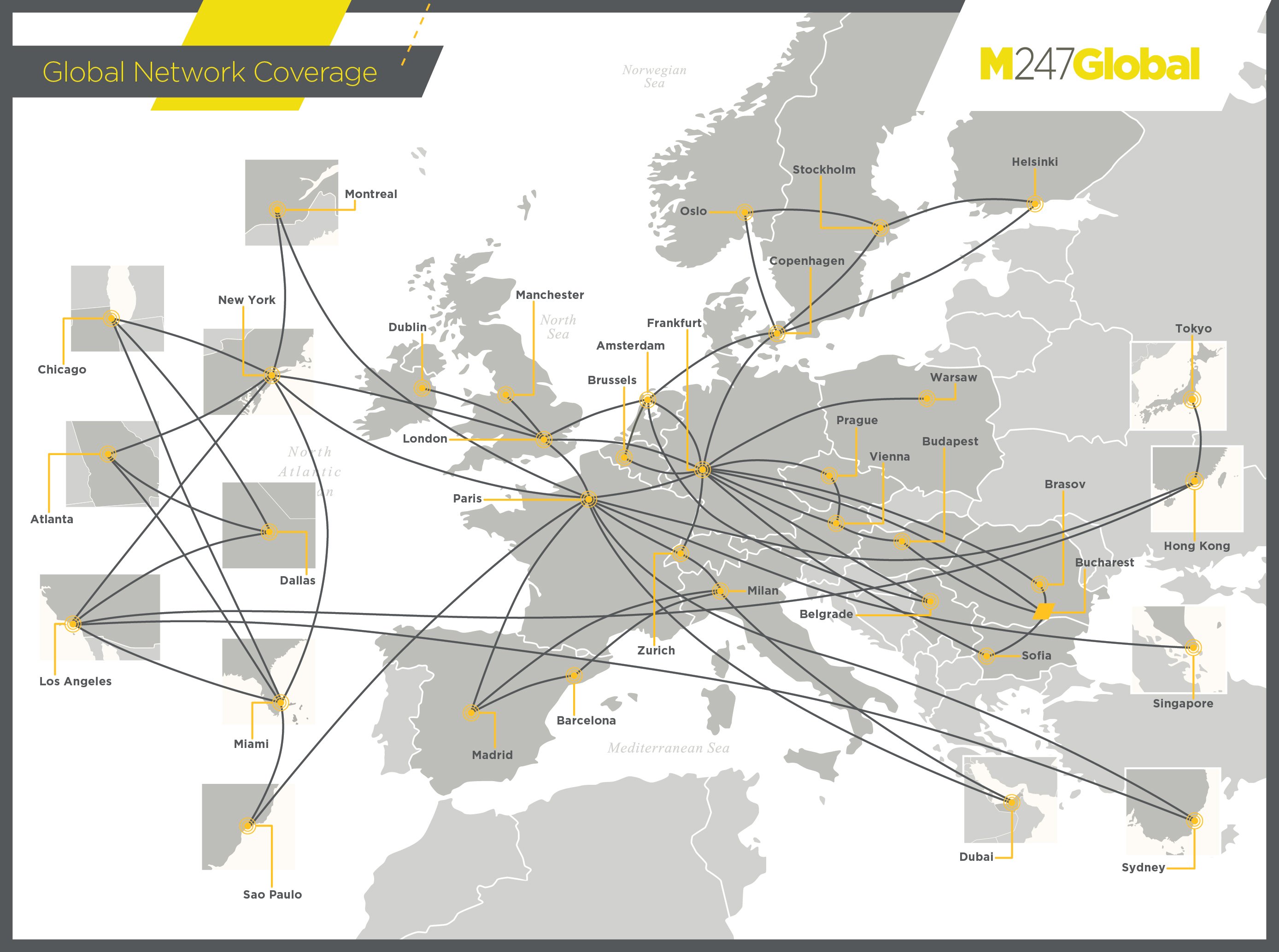
M247 Global provides hosting and connectivity solutions that let you configure a digital architecture built to scale and to bring edge access to users across the most diverse regions of the world — powered by our global network of 55+ PoPs spanning five continents.
Our global hosting services help organisation to have a fast time to market, especially in the current economy. Research by McKinsey shows that being late to market by just six months results in 33% less earnings, that competition, over a five-year period.
What Global Hosting Actually Means
Global hosting isn't just "having servers in more than one country." It's an architecture where an application runs across multiple data centers, each capable of serving traffic, so that performance and availability don't depend on a single point of failure or a single geography.
The difference shows up the moment you measure it. A user in Bucharest reaching a server in Bucharest or Frankfurt gets a response in 10–20ms. The same user reaching a server in Singapore can wait over 250ms. For anything interactive — CRM systems, gaming, e-commerce checkouts, video calls, AI workloads — that gap is the difference between an application that feels instant and one that feels sluggish.
Why It Matters: Five Practical Reasons
- Lower latency. Proximity between server and user is the single biggest lever for response time. The closer the infrastructure, the faster the experience.
- Higher availability. If one data center goes down — power failure, hardware fault, network disruption, a DDoS attempt — traffic shifts to another location. Users typically notice nothing more than a brief delay, if that.
- Faster expansion into new markets. A company doesn't need to build infrastructure in every country it wants to serve. It can extend into Europe, the US, the Middle East, or Asia using capacity that already exists, rather than starting a new build each time.
- Data residency compliance. Some jurisdictions require certain categories of data to stay within their borders — personal data under EU rules, government platforms, healthcare records. Global hosting gives you the option to choose where specific data lives.
- Business continuity. When a major incident hits one region, operations can continue from another, rather than stopping until the original site recovers.
How It Works in Practice
Global hosting is less a single product and more a combination of infrastructure choices working together.
|
Component |
What it does |
Why it matters |
|
Multiple POPs |
Hosts the same application in several regions (e.g., Bucharest, Frankfurt, London) |
Removes single points of failure |
|
Data replication |
Synchronizes databases across locations |
Keeps operations running if one site goes offline |
|
Intelligent DNS routing |
Directs each user to the nearest or most suitable location |
Cuts latency automatically, without manual intervention |
|
Load balancing |
Distributes traffic across available servers |
Prevents any one server from becoming a bottleneck |
|
Regional network presence |
Connects data centers through well-provisioned network paths |
Keeps routing efficient between regions |
Two architectural models are common. In an active-passive setup, one data center handles production traffic while a second stands ready to take over if needed — simpler and more cost-effective. In an active-active setup, multiple data centers serve traffic simultaneously, splitting the load — better performance and resilience, at the cost of more complex synchronization. Which one makes sense depends on the application, the budget, and how much downtime the business can tolerate.
Where This Shows Up: Real Scenarios
Cross-border e-commerce. A retailer selling into Romania, Germany, France, and Italy hosts from Bucharest and Frankfurt. Each customer connects to the nearest site — pages load faster, and fewer carts get abandoned over slow checkout.
SaaS platforms. A company with customers across Europe, the US, and Asia runs its application from multiple regional locations, so each customer reaches the instance closest to them instead of routing halfway around the world.
AI and compute-intensive workloads. When GPU or CPU capacity in one region is saturated, workloads shift to another location automatically, keeping processing on schedule.
Disaster recovery. A company's primary infrastructure runs in Bucharest, with virtual machines replicated to Brașov. If a major incident hits the primary site, services can be brought up from Brașov quickly, keeping the disruption to a minimum.
Who Actually Needs This
Global hosting delivers the most value for companies with users spread across multiple countries, SaaS and cloud platforms, international e-commerce operations, financial and fintech services, AI platforms with heavy processing demands, and organizations where uptime and continuity are non-negotiable.
That said, it isn't the right fit for everyone. A company operating purely in a local market, with users concentrated in one region, may get a better cost-to-value ratio from a well-designed regional setup with solid redundancy and backup — without the added complexity of a multi-region architecture. Global hosting earns its cost when performance across regions, resilience, and international growth are genuine business priorities, not just nice-to-haves.
Scaling Globally, Without Guessing
The right architecture depends on where your users are, how critical uptime is to your business, and how fast you plan to grow. Getting it wrong in either direction — over-building for a local business or under-building for an international one — costs money and performance.
M247 Global's architecture team works with companies to map out exactly this: which regions matter, which model fits the workload, and how to build a setup that scales as the business does.
Get in touch with our architecture team to talk through the right global hosting approach for where your company is headed. And meanwhile just take a look at our global network footprint and convince yourself that you could think big with M247 Global.
FAQs
1. What's the difference between global hosting and simply hosting in one large data center? A single data center, however powerful, is still one point of failure and one source of latency for distant users. Global hosting spreads the application across multiple locations, addressing both issues at once.
2. Does global hosting mean my data is duplicated everywhere? Not necessarily. Replication is typically targeted — critical data is synchronized between specific locations based on your continuity and compliance needs, not scattered indiscriminately.
3. Is global hosting only useful for large enterprises? No. Any company with users in multiple regions, or with strict uptime requirements, can benefit — the scale of the setup is adjusted to the business, not the other way around.
4. How do I know if my company needs global hosting or a strong regional setup is enough? It depends on where your users are and how much cross-region performance and resilience matter to your business. M247 Global's architecture team can assess your specific case and recommend the right fit.