

What is this article about:
- Why IT Infrastructure Costs Continue to Increase
- AI Is Reshaping Infrastructure Economics
- The Hidden Costs of On-Premises Infrastructure
- Why Colocation Has Become a Strategic Alternative
- How Colocation Reduces IT Infrastructure Costs
- On Prem versus Colocation, Cost Comparison Framework
- Enterprise Colocation with M247 Global
Rising IT infrastructure costs are becoming one of the biggest barriers to digital transformation. Organizations are expected to deliver higher performance, stronger resilience, enhanced cybersecurity, and always-on availability - while IT budgets remain flat or grow only marginally. At the same time, the rapid adoption of AI workloads, advanced analytics, and data-intensive applications is fundamentally changing infrastructure economics.
This raises a critical question for every CIO and CTO: How much of your IT budget is actually wasted on inefficient infrastructure operations?
According to a 2025 LeanX IT survey, 52% of respondents estimate that between 10% and 20% of their organization’s IT budget is wasted annually.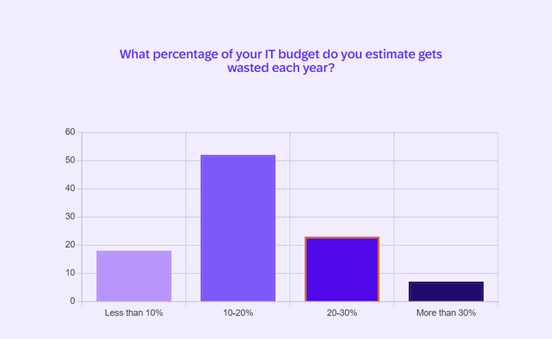 Much of this waste comes from inefficient infrastructure utilization, aging server rooms, excessive energy consumption, fragmented operations, and hidden operational overhead.
For many organizations, traditional on-premises infrastructure is no longer financially sustainable—or operationally agile enough—to support modern business demands.
Why IT Infrastructure Costs Continue to Increase
Several structural trends are putting constant pressure on enterprise infrastructure budgets, making traditional on-premises environments increasingly difficult and expensive to maintain
- Rising Hardware Costs
The rapid growth of AI workloads has significantly increased global demand for high-performance servers, GPUs, enterprise storage systems, and advanced memory technologies. Supply chain constraints and shortages in high-end components continue to drive acquisition costs higher, making infrastructure refresh cycles substantially more expensive than in previous years. - Higher Performance and Scalability Requirements
Modern IT infrastructure must support far more complex and demanding environments than ever before. Organizations are running AI applications, real-time analytics platforms, automation tools, cloud-native workloads, and large-scale data processing systems simultaneously. Infrastructure is no longer expected simply to run applications—it must deliver low latency, operate at scale, and support continuous innovation and faster development cycles. - Increasing Operational Expenses
As compute density and storage demand grow, operational costs are rising sharply. Power consumption, cooling requirements, connectivity, redundancy systems, physical security, and compliance obligations all contribute to higher ongoing infrastructure spending. AI-driven workloads, in particular, are placing unprecedented pressure on energy efficiency and facility operations. - The Growing Financial Impact of Downtime
Infrastructure outages now carry far greater business consequences than in the past. Availability and resilience are directly tied to customer trust, cybersecurity posture, regulatory compliance, and overall business continuity. Even short disruptions can generate significant financial losses, operational delays, and reputational damage, forcing organizations to invest heavily in redundancy and high-availability environments.
On this topic read also ”A server crisis is anticipated. High costs and delayed deliveries. What are the alternatives?”
AI Is Reshaping Infrastructure Economics
The rapid adoption of AI technologies is fundamentally changing how organizations think about infrastructure investments. McKinsey’s latest survey on the state of AI project that infrastructure-related costs could increase two to three times by 2030 as organizations scale AI initiatives and data-intensive services.
At the same time, many organizations are discovering that their existing environments are not designed to support modern AI workloads efficiently. Traditional server rooms often lack the power density, cooling capacity, connectivity, and operational resilience required for advanced computing environments.
This creates a difficult balancing act for CIOs and CTOs. Infrastructure must become faster, more scalable, and more resilient while operational budgets remain under pressure. The challenge is no longer simply acquiring better technology. The real challenge is operating that infrastructure efficiently.
The Hidden Costs of On-Premises Infrastructure
Most organizations calculate infrastructure spending by focusing on obvious costs such as server hardware, software licensing, IT staff salaries, and maintenance contracts. However, the real Total Cost of Ownership (TCO) of an on-premises environment is significantly higher.
One of the most overlooked costs is operational inefficiency. Highly skilled IT professionals often spend substantial amounts of time managing cooling systems, troubleshooting power issues, replacing failed hardware, or handling routine facility maintenance instead of focusing on strategic projects.
Aging infrastructure also creates hidden financial pressure. Older server rooms become increasingly expensive to maintain, consume more energy, and typically operate far below modern efficiency standards. Many organizations continue investing in inefficient facilities simply because the true long-term cost is difficult to measure directly.
Business risk is another major hidden expense. Infrastructure outages, environmental failures, insufficient redundancy, or poor physical security can create operational disruptions that extend far beyond IT departments.
In many cases, organizations underestimate these indirect costs because they are distributed across multiple departments and operational budgets rather than appearing as a single infrastructure expense.
Why Colocation Has Become a Strategic Alternative
For organizations struggling with rising IT infrastructure costs, colocation offers a practical way to reduce operational expenses without losing control over critical systems.
Instead of maintaining expensive on-premises server rooms, businesses can relocate their infrastructure into a professional Tier III data center while still retaining ownership of their hardware and applications. The data center provider becomes responsible for the infrastructure layers that are expensive and operationally complex to maintain internally, including power delivery, cooling systems, physical security, connectivity, environmental monitoring, and facility resilience.
This allows organizations to focus internal resources on delivering business value rather than operating infrastructure facilities.
How Colocation Reduces IT Infrastructure Costs
Facility and Space Optimization
Building and operating an internal data center requires substantial investment in real estate, electrical systems, fire suppression infrastructure, cooling equipment, and physical security. In many cases, server rooms occupy valuable office space in premium business locations where operational costs are already high.
Colocation transforms these fixed infrastructure investments into predictable operational expenses. Instead of building and maintaining oversized facilities for future growth, organizations lease only the space they actually require.
This approach provides significantly greater financial flexibility while eliminating large capital expenditures related to facility management.
Improved Power and Cooling Efficiency
Power and cooling represent some of the largest ongoing infrastructure expenses.
A key efficiency indicator in data center operations is PUE (Power Usage Effectiveness). Traditional on-premises server rooms frequently operate at a PUE above 2.0, meaning that for every watt consumed by IT equipment, another watt or more is required for cooling and facility overhead. Modern enterprise-grade data centers typically operate between 1.1 and 1.3 PUE, dramatically reducing energy waste and operational inefficiency.
The difference has a direct financial impact. Lower energy consumption reduces operational costs while also supporting sustainability objectives and ESG initiatives.
In addition, colocation providers benefit from economies of scale that most enterprises cannot achieve independently. Large-scale facilities can optimize cooling systems, negotiate better electricity pricing, and maintain highly efficient redundant infrastructure environments.
Lower Infrastructure Refresh Costs
Organizations operating on-premises environments must regularly replace not only servers and storage systems, but also supporting infrastructure such as UPS systems, cooling equipment, backup generators, and electrical distribution systems.
These refresh cycles are expensive and often difficult to predict.
With colocation, businesses remain responsible only for their IT hardware. The provider handles facility-level infrastructure upgrades and maintenance, significantly reducing long-term capital investment requirements.
Reduced Operational Overhead
Maintaining a modern data center environment requires specialized expertise in facilities management, electrical systems, environmental monitoring, physical security, and 24/7 operational support.
These operational requirements create substantial staffing and maintenance costs that are frequently underestimated during infrastructure planning.
Colocation providers distribute these operational costs across multiple customers while offering enterprise-grade support services that would be difficult or expensive for many organizations to maintain internally.
As a result, internal IT teams can focus on strategic initiatives such as cybersecurity, digital transformation, AI adoption, and application modernization rather than day-to-day infrastructure operations.
Cost Comparison Framework
|
Cost Category |
On-Premises |
Colocation |
|
Facility & Space |
High (Cost of buying/building the data center, real estate footprint, and property taxes) |
Low to Medium (Lease only the exact space required, from rack units to full cabinets or cages) |
|
Power & Cooling |
High and variable (Own HVAC systems, backup generators, utility costs) |
Shared and optimized (Lower PUE, economies of scale, predictable costs) |
|
Hardware Refreshes |
High (Servers, UPS systems, cooling systems, electrical infrastructure) |
Moderate (Refresh only IT equipment; provider maintains facility infrastructure) |
|
Staffing & Operations |
High (Requires in-house facility operations and 24/7 support resources) |
Lower (Shared operational services and optional remote hands support) |
Infrastructure Efficiency Is Now a Competitive Advantage
As businesses become increasingly digital and AI-driven, reducing operational inefficiency has become one of the few realistic ways to control infrastructure spending.
Organizations cannot significantly reduce demand for compute power, storage, or connectivity. However, they can optimize how infrastructure is operated and where workloads are hosted.
This is why colocation is increasingly viewed not simply as a hosting decision, but as a long-term operational strategy. It allows organizations to improve resilience, scalability, and efficiency while reducing the hidden costs associated with maintaining aging on-premises environments.
Most importantly, it enables IT departments to focus on innovation instead of infrastructure maintenance.
Enterprise Colocation with M247 Global
Organizations looking to reduce IT infrastructure costs while maintaining high availability and operational control can leverage enterprise-grade colocation services from M247 Global Colocation Services.
With data centers in Bucharest and Brașov, M247 Global provides secure, resilient, and high-performance environments designed for modern enterprise workloads, AI infrastructure, and mission-critical applications.
FAQ
Why are IT infrastructure costs increasing?
IT infrastructure costs are rising due to AI workloads, growing compute and storage demands, higher energy consumption, hardware shortages, and increasing requirements for resilience, cybersecurity, and high availability.
What are the hidden costs of on-premises infrastructure?
Beyond hardware and software, on-premises environments generate hidden costs related to power, cooling, maintenance, downtime risks, facility operations, and IT staff time spent managing infrastructure instead of strategic projects.
How does colocation reduce IT infrastructure costs?
Colocation reduces costs by moving infrastructure into a professional data center with optimized power, cooling, security, and connectivity. Organizations keep control of their hardware while reducing operational overhead and facility expenses.
Why is colocation a good option for AI-ready infrastructure?
AI workloads require high-performance, scalable, and energy-efficient environments. Colocation provides the power density, cooling capacity, connectivity, and resilience needed to support modern AI and data-intensive applications more efficiently than traditional server rooms.