

Hybrid cloud has stopped being a temporary stop on the road to "all public cloud." It's now the default architecture for mature organizations, and the numbers back it up: Fortinet's latest Cloud Security Report puts 88% of organizations in hybrid or multi-cloud territory, while Flexera's 2026 State of the Cloud Report finds 73% running hybrid environments — against just 2% on private cloud alone and 9% purely on public cloud. Also, Gartner names hybrid computing one of the top infrastructure and operations trends for 2026.
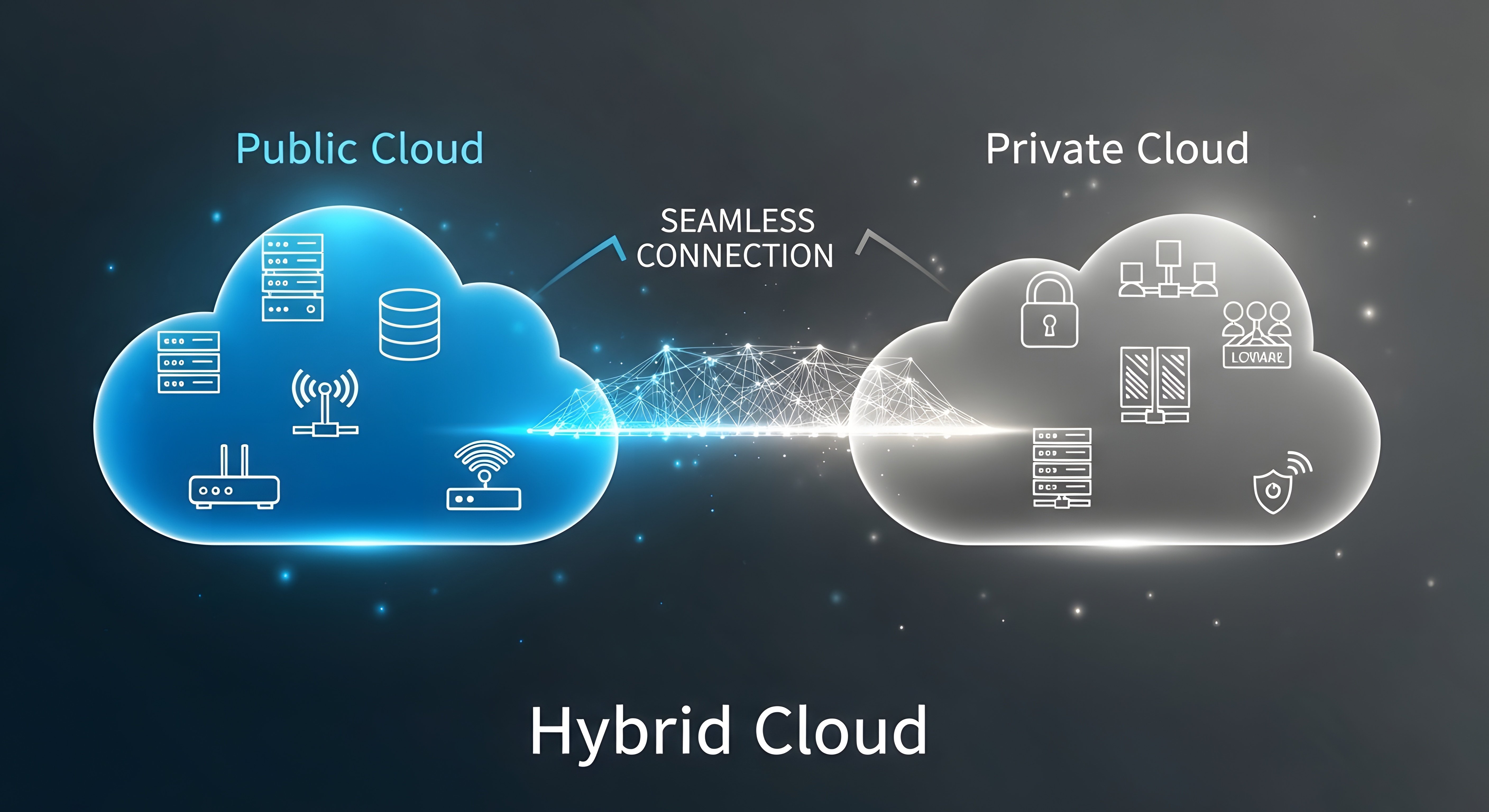
M247’s Hybrid Cloud integrates Private and Public Cloud platforms, giving businesses the ideal balance of security, flexibility, and cost-efficiency for applications - from mission-critical workloads to non-critical business services.
In this article you will read about:
- What Hybrid Cloud Really Means
- On-Premises vs Public Cloud vs Hybrid: A Side-by-Side Comparison
- Why Hybrid Has Become the Default Model
- What a Hybrid Environment Needs to Function Efficiently
What Hybrid Cloud Really Means
At its core, hybrid cloud is the coordinated use of two or more infrastructure environments — public cloud, private cloud, colocation facilities, and on-premises systems — run as a single, unified operating environment rather than a collection of isolated silos. The defining trait isn't simply using multiple environments; almost every organizationion already does that. What makes it hybrid is the orchestration of workloads, data, and policies across those environments based on cost, performance, compliance, and latency — instead of leaving workloads wherever they happened to land.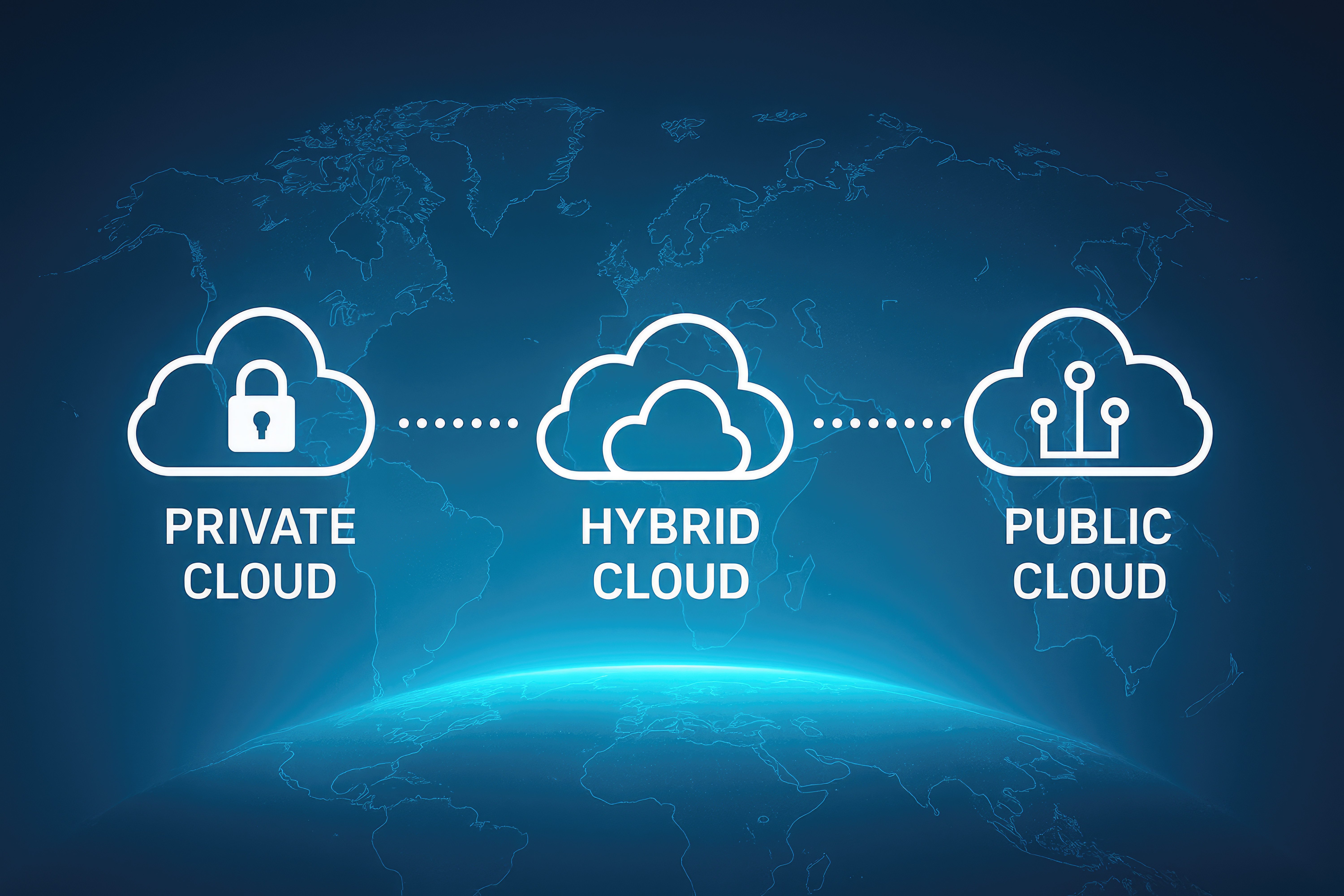 That distinction matters. Running some applications on-premises and others in the public cloud doesn't, by itself, add up to a hybrid cloud strategy. It's just distributed infrastructure. Hybrid cloud becomes a real strategy the moment identity, security, networking, and observability are managed consistently across every environment — letting IT teams deploy, and just as importantly relocate, workloads without redesigning how they're secured, monitored, or operated.
On-Premises vs Public Cloud vs Hybrid: A Side-by-Side Comparison
Choosing between these models is rarely all-or-nothing. But seeing where each one performs best explains why most organizations end up combining them rather than betting on a single approach.
|
Category |
On-Premises |
Public Cloud |
Hybrid Cloud |
|
Cost model |
High CapEx, predictable ongoing costs |
Pay-as-you-go OpEx; elastic but can be unpredictable |
Fixed costs for steady workloads, elastic spending for variable demand |
|
Scalability |
Limited by physical capacity; expansion takes weeks or months |
Near-instant, virtually unlimited |
Elastic where required, predictable where stable |
|
Control & security |
Full operational control and audit ownership |
Shared responsibility model with strong provider certifications |
Unified policies while regulated workloads stay under direct control |
|
Data sovereignty |
Full control over data location |
Dependent on provider regions |
Sensitive data stays on controlled infrastructure; other workloads use the cloud |
|
Performance & latency |
Ideal for latency-sensitive local workloads |
Dependent on network and cloud region |
Latency-critical workloads stay close to users; others run where capacity and cost favor them |
|
Disaster recovery |
Requires a dedicated secondary site |
Built-in cross-region redundancy |
Cloud can serve as DR target for on-premises infrastructure, or vice versa |
|
Time to deploy |
Weeks to months |
Minutes to hours |
Rapid for cloud resources; physical infrastructure follows traditional timelines |
|
Skills & lock-in |
Traditional infrastructure expertise; minimal lock-in |
Cloud-native skills; higher lock-in risk |
Requires expertise across both, reduces lock-in through open standards |
|
Typical use cases |
Legacy ERP, regulated workloads, predictable applications |
Customer-facing apps, burst workloads, rapid scaling |
Regulated core workloads plus elastic cloud and AI infrastructure |
The takeaway: on-premises infrastructure and public cloud aren't competing approaches — they're complementary ones, each suited to different workloads. Hybrid cloud isn't a compromise between the two. It's the architecture that lets organisations place every workload where it delivers the best balance of performance, cost, resilience, and compliance.
Why Hybrid Has Become the Default Model
Three forces have pushed hybrid cloud from an architectural option to the default operating model.
Workload diversity. AI training and inference, legacy ERP platforms, latency-sensitive applications, and predictable transactional systems each have fundamentally different performance and cost profiles. Few organizations can justify forcing every workload into the same environment. Gartner points to this diversity as a primary driver behind hybrid computing: it lets organizationss protect existing investments while supporting next-generation AI infrastructure, without choosing between legacy systems and cloud-native platforms.
Cost optimisation. Public cloud pricing is elastic by design, which suits unpredictable or seasonal demand well. But that same model can become less economical for stable, high-volume workloads, where usage-based billing and data egress charges push up total cost of ownership. Private infrastructure and colocation offer predictable, fixed-cost alternatives for workloads that don't need cloud elasticity.
Risk management and regulatory compliance. Organizationssations in finance, healthcare, and the public sector increasingly have to show where their data lives, who controls it, and how it's protected. Hybrid architectures let them keep sensitive or regulated workloads on infrastructure they directly control, while still tapping public cloud services for less-constrained applications.
The scale of the shift shows up clearly in the data: with 88% of organizations running hybrid or multi-cloud environments and 73% specifically adopting hybrid cloud (Flexera's 2026 State of the Cloud Report), the old "cloud-first" mindset has quietly given way to something more pragmatic — cloud where it makes sense.
What a Hybrid Environment Needs to Function Efficiently
Running workloads across multiple environments is the easy part. Running them as one coherent operating model is where most hybrid cloud strategies succeed or fail. Four capabilities make the difference.
- Unified Identity and Access Management. Every environment in a hybrid infrastructure should authenticate users against a single source of truth. Federated identity, single sign-on (SSO), and centrally enforced IAM policies across on-premises, colocation, and public cloud eliminate fragmented identity management—one of the most common causes of security gaps.
- High-Performance Private Connectivity. A hybrid architecture depends on fast, reliable connectivity. Low-latency, high-availability links—through dedicated interconnects, private peering, or high-capacity Layer 2 networks—ensure applications perform consistently without relying on the public internet.
- A Common Orchestration and Automation Layer. Containers and Kubernetes enable workloads to run consistently across platforms, while Infrastructure-as-Code tools such as Terraform and Ansible keep environments aligned, reduce configuration drift, and automate deployment and recovery. Together, they create a unified operational environment.
- Unified Observability. Monitoring, logging, metrics, tracing, and alerting should feed a single observability platform, giving IT teams complete visibility across the hybrid estate. Without it, troubleshooting becomes fragmented and operational complexity quickly grows.
This is exactly what M247 Global is offering to the market. Delivering a seamless integration between private and Public Cloud environments, M247's Hybrid Cloud solutions provide the flexibility, security and value that your business needs with intelligent workload placement.
Whether you're looking for better cloud computing value, to enhance security, or to lock down your business continuity, our Hybrid Cloud solutions provide the ideal foundation for your IT strategy. Get a personalised quote for hybrid cloud right now.
FAQs
Is hybrid cloud the same as multi-cloud? No. Hybrid cloud combines public cloud with private or on-premises infrastructure, while multi-cloud means using services from multiple public cloud providers. Many organizationsisations run both at once.
How do I know if hybrid cloud is right for my organizationnisation? If you're already running workloads across more than one environment, you're already on the path to hybrid. The key is managing those environments as a single, coordinated platform rather than separate silos.
Next in this series: the operational challenges hybrid cloud creates for IT teams, and the best practices that separate organizationsisations that manage it well from those that don't.