

Romania's data center market is growing, but commercial colocation options remain more limited than in Europe's major data center hubs. In Bucharest, where a significant share of the country's infrastructure is concentrated, occupancy rates are estimated at 90–95%. Availability is higher nationwide, but finding a provider that meets all technical and operational requirements can still be challenging.
For companies looking for server colocation in Romania, the decision should not come down to rack pricing or electricity costs alone. Capacity availability, redundancy, connectivity, security, and contract terms can have a much greater impact on business operations over the long term.
Switching providers later is not a simple process. Relocating physical infrastructure involves transporting equipment, reconfiguring connections, making network changes, and, in some cases, scheduling service downtime.
Server Colocation in Romania: Availability Comes First
According to the JLL 2026 Global Data Center Outlook, access to power has become the primary criterion for data center selection, ahead of location or cost. Globally, JLL reports a 97% occupancy rate and forecasts average annual rental rate growth of approximately 5% through 2030.
Capacity constraints are particularly evident in Europe's major data center hubs, where securing a new grid connection can take years. Romania does not face the same level of demand, but neither does it offer the range of options available in markets such as Frankfurt, London, or Paris.
A location should therefore be assessed against each company's specific requirements: proximity to users, latency, international connectivity, costs, and actual infrastructure availability.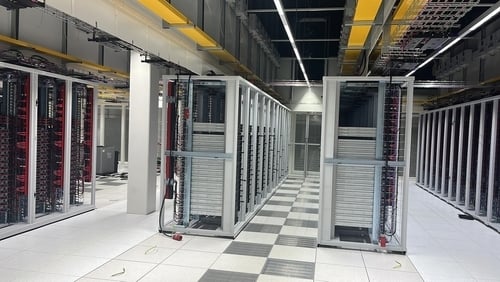 For customers, the first question is straightforward: Is space and power available today, and will there be enough capacity to expand in two or three years?
Available rack space alone is not enough. The operator must also be able to provide the required power, adequate cooling capacity, and the necessary connectivity.
M247 Global offers flexible configurations, from single-server colocation (1U or 2U) to full racks, with power options of 3, 6, or 9 kVA. For higher-density infrastructure, custom configurations can be evaluated based on technical requirements and available capacity.
What Questions Should You Ask Before Signing a Contract?
1. What Level of Availability Is Guaranteed by the SLA?
A data center may have redundant equipment, but what matters to customers is how that redundancy translates into service availability.
Key considerations include the power distribution architecture, UPS systems, generator autonomy, and cooling redundancy. It is also important to determine whether servers can use two independent power feeds (A+B) and whether infrastructure maintenance can be performed without service interruption.
There is also an important distinction between a data center's Tier architecture and its contractual Service Level Agreement (SLA). The former describes infrastructure characteristics, while the latter defines guaranteed availability, measurement conditions, and potential service credits.
What does M247 Global offer? Our colocation infrastructure is built to Tier 3 specifications, with redundant UPS systems in a 2(N+1) configuration, generators providing at least 16 hours of autonomy, and N+1 redundant precision cooling. Availability exceeds 99.99%, with applicable conditions defined through SLAs tailored to each customer.
2. What Connectivity Options Are Available?
For many applications, performance depends just as much on connectivity as on the servers running them.
A data center should be evaluated based on the telecom carriers available, connection capacity, latency to end users, and the presence of physically diverse fiber routes. A single high-speed connection does not provide the same resilience as two connections operating over separate routes. If infrastructure needs to connect to other offices, cloud platforms, or data centers, check the availability of Layer 2 Ethernet services, Layer 3 VPNs, and private connections. Cross-connect costs also matter, as they can significantly affect monthly expenses.
M247 Global offers a key advantage by integrating colocation services with its own global network infrastructure. Our portfolio includes IP Transit, point-to-point Ethernet connectivity, private VPN services, and cross-connects to carriers and partners. This allows colocated infrastructure to connect to other locations or IT services without having to source every component separately.
3. How Much Power Can You Use per Rack?
A standard 42U rack does not necessarily mean that every unit can be populated with any type of equipment. The actual limit is often determined by available electrical power and cooling capacity.
For example, a configuration of ten servers consuming 500 W each requires approximately 5 kW for the servers alone, excluding switches, auxiliary equipment, and operational headroom.
Before signing a contract, check the maximum allocated power, whether it is expressed in kW or kVA, the conditions for increasing capacity, and how electricity consumption is measured.
At M247 Global, we offer full racks with 3, 6, and 9 kVA power options, as well as custom configurations for requirements exceeding 9 kVA, assessed individually. Our infrastructure uses precision cooling systems with temperature and humidity monitoring. For high-density equipment, compatibility must be confirmed during the solution design stage.
4. Who Responds When Something Goes Wrong?
What happens if a server needs a physical reboot at 3 a.m.? Or if a disk needs replacing, a cable needs checking, or a hardware issue needs diagnosing?
Remote Hands services allow data center personnel to perform physical operations without requiring the customer's IT team to travel to the facility. However, not all contracts include the same types of intervention. Check 24/7 support availability, response times, included operations, and rates for additional interventions. Physical access procedures, visitor authorization, and access logs should also be clarified.
M247 Global's colocation services include access to our technical team through the Hosting Operations Center (HOC), available 24/7/365 for monitoring and support. Remote Hands services are also available on request.
Physical security includes access control, continuous video surveillance, intrusion detection systems, and additional biometric authentication options.
5. What Is the Real Cost of Colocation?
Two offers with the same monthly rack price can have very different total costs.
Some include a defined amount of electricity consumption and network traffic, while others charge separately for reserved power, actual energy consumption, connectivity, or technical interventions. Additional charges may apply for IP addresses, cross-connects, installation, and capacity expansion.
For a meaningful comparison, request a total cost estimate over 24 or 36 months, including any potential price adjustments. To provide an accurate quote for server colocation in Romania, we need to understand several aspects of your infrastructure requirements.
The M247 Global colocation portfolio includes configurations ranging from 1U and 2U spaces to quarter racks (10U), half racks (20U), and full racks. Depending on the configuration, packages may include traffic allowances and IP addresses.
This approach allows services and costs to be sized according to actual requirements, without committing to a full rack when the infrastructure occupies only a few rack units.
6. What Happens If You Need to Expand or Move?
A colocation contract should also be evaluated in the context of future changes.
Can the company add servers or racks without migrating its entire infrastructure? Is additional power capacity available? Can it combine its own servers with cloud services or dedicated servers? What terms apply to contract renewal or termination?
Migrating to another provider involves planning equipment shutdowns, transportation, reconnection, testing, and network configuration updates. For mission-critical systems, a period of parallel operation across both environments may be necessary.
Beyond colocation, M247 provides dedicated servers, cloud services, connectivity, and disaster recovery solutions through its second data center located in Brașov, Romania.
Customers can therefore combine their own equipment with outsourced resources and build hybrid architectures without relying exclusively on the physical infrastructure installed in a single rack.
Price Matters, but Flexibility May Matter More
When evaluating server colocation in Romania, costs should be assessed over the full contract term, not just at the point of signing.
An initially cheaper offer may become more expensive if it involves additional charges for connectivity, technical interventions, or increased power allocation. At the same time, a rigid contract may limit infrastructure growth as business requirements evolve. The JLL 2026 report also highlights another trend: hybrid infrastructure portfolios are becoming the default model, with companies combining on-premises servers, colocation, hyperscale cloud services, and edge infrastructure.
This shift makes service integration an increasingly important consideration when choosing a provider.
Technical Checklist for Choosing a Colocation Provider
The following nine criteria summarize the key areas to assess before signing a contract.
|
Criterion |
What to Check |
Why It Matters |
|
1. Available capacity |
Space, power availability, and expansion options |
Prevents deployment delays and capacity constraints |
|
2. Location and latency |
Proximity to users, cloud platforms, and other data centers |
Affects application performance and operational continuity |
|
3. Connectivity |
Telecom carriers, diverse routes, cross-connects, cloud connectivity |
Reduces dependence on a single carrier or network path |
|
4. Power density and cooling |
kW per rack, redundant cooling, high-density support |
Determines which equipment can be installed and expanded |
|
5. Compliance |
ISO 27001, audit reports, GDPR, NIS2, or PCI DSS requirements, where applicable |
Supports the company's security and audit requirements |
|
6. Resilience |
UPS, generators, A+B power feeds, N+1 cooling, SLA |
Reduces the risk of infrastructure-related outages |
|
7. Total cost |
Space, power, traffic, IP addresses, cross-connects, Remote Hands |
Enables accurate long-term cost comparisons |
|
8. Contract terms |
Duration, price escalation, expansion, termination, SLA credits |
Limits financial and operational risks |
|
9. Operator and support |
Experience, 24/7 staffing, response times, additional services |
Ensures ongoing support throughout the contract |
M247 Global: Colocation, Connectivity, and Flexibility in One Ecosystem
Choosing a provider for server colocation in Romania involves much more than renting space in a data center. It means securing access to redundant power and cooling infrastructure, high-performance connectivity, physical security, and specialized technical support.
M247 Global brings these capabilities together in a portfolio covering server colocation, connectivity, cloud services, and dedicated infrastructure.
From a single server to full-rack configurations, solutions can be sized according to each customer's technical and operational requirements.
Looking for space to host your company's servers? Talk to the M247 Global team about your power requirements, connectivity, redundancy, and expansion plans to identify a solution that supports both your current needs and future growth.