

A hyperscale data centre is a building with tens or hundreds of megawatts of IT capacity, used by a single major cloud or internet company, while hyperscale cloud is the service that company sells. In practice, almost no organisation builds its own hyperscale data centre. For most IT teams, the choice is whether each workload should run in public cloud, colocation or a combination of the two.
In this article, we compare the two infrastructure models, explaining where each one makes financial and operational sense. We also examine the power and cooling requirements of AI infrastructure, and set out the questions to answer before deciding where a workload should run.
What is a hyperscaler?
A hyperscaler is a company that operates cloud or internet services at global scale and builds or leases the data centres behind them. Synergy Research Group counts the large data centres operated by 21 major cloud and internet companies. Its April 2026 analysis counted 1,360 hyperscale data centres at the end of 2025, representing 48% of worldwide data centre capacity.
Data centres are commonly grouped into four types: enterprise, colocation, service-provider and hyperscale facilities. In its 2025 report, the International Energy Agency combines colocation and service providers into one category. Under this classification, hyperscale facilities account for 37% of capacity, colocation and service providers for 36%, and enterprise data centres for about 28%. These percentages are not directly comparable with Synergy’s figures because the two organisations classify capacity differently.
Is a hyperscaler the same as a data centre?
No, they are not the same, since a hyperscaler is the company, while a data centre is a physical facility. The term “hyperscale” is used in three related ways:
- The company: a global cloud or internet operator with data centres in many regions.
- The building: a hyperscale data centre with tens or hundreds of megawatts of IT capacity, designed for one hyperscaler and usually occupied by that company alone.
- The service: hyperscale cloud, where customers buy computing, storage and platform services without owning the underlying hardware.
IDC has defined a hyperscale data centre as having at least 5,000 servers and 10,000 square feet of space, although such facilities are generally much larger. Data centre capacity is now commonly measured in megawatts. One megawatt of IT capacity is the electrical power available to the IT equipment housed in the facility. The IEA uses 25 MW as a reference size for a conventional data centre and 100 MW for a hyperscale facility. Buying hyperscale cloud is an infrastructure sourcing decision; building a hyperscale data centre is a major construction programme undertaken by hyperscalers.
Hyperscale data centres vs colocation: how they differ
A hyperscale data centre is a facility of tens or hundreds of megawatts, built or leased for one cloud or internet operator. Colocation means renting space, power, cooling and connectivity in a provider's data centre for hardware your organisation owns.
| Criterion | Hyperscale data centre | Colocation |
|---|---|---|
| Building owner | The hyperscaler or a wholesale developer leasing the facility to it | The colocation provider |
| Users | Usually one hyperscaler | Multiple organisations, from one server to dedicated halls |
| Typical size | Tens or hundreds of MW | From individual rack capacity to multi-megawatt deployments |
| Facility operator | The hyperscaler or its contracted operator | The colocation provider |
| Cost model | Heavy capital expenditure (CapEx, money spent to build or buy assets) for construction, followed by operating expenditure (OpEx, recurring costs for services) | Recurring OpEx for contracted space, power and services; the customer still funds its hardware |
| Time to capacity | Years for land, power, design, construction and commissioning | Months when suitable space and power are available |
| Connectivity | Designed around the hyperscaler's own network | Access to carriers, internet exchanges and cloud connections varies by facility |
| Energy efficiency | Highly standardised campuses often achieve lower PUE | PUE varies with the facility's age, design, load and cooling system |
| Suited to | Companies whose product depends on operating compute at global scale | Organisations that need dedicated hardware and location control without running the facility |
Power usage effectiveness, or PUE, measures the relationship between all the power used by a data centre and the power consumed directly by its IT equipment. The closer the figure is to 1.0, the less energy is required for cooling and other facility systems. The IEA puts efficient hyperscale facilities at just under 1.15. By comparison, Uptime Institute reported an industry average of 1.52 in 2026, while Google reports 1.09 across its fleet. Achieving similar unit costs requires the scale, standardisation and utilisation levels of a hyperscale operator.
JLL expects global data centre capacity to nearly double from 103 GW to 200 GW by 2030, counting hyperscale, colocation and on-premises facilities.
Do hyperscalers use colocation?
Yes: almost 60% of hyperscale capacity is in own-built, owned data centres, and the rest is in leased facilities, according to Synergy Research Group's April 2026 data. Hyperscalers therefore combine facilities they build and own with capacity leased from colocation providers.
This reliance on leased space is visible across the colocation market: Uptime Institute found in 2025 that almost two-thirds of colocation providers hosted hyperscale customers, which occupied an average of 44% of their space. JLL describes the hyperscaler approach as a dual strategy of leasing and self-building. In the UK, a Department for Science, Innovation and Technology compute annex, citing McKinsey analysis of 2024 data, estimated that hyperscalers leasing wholesale colocation accounted for 58% of the country's data centres.
The lease usually differs from the colocation bought by an enterprise. Hyperscalers tend to take large blocks of power and space, sometimes an entire hall or building, under long wholesale colocation contracts. Retail colocation serves organisations that need a rack, cage or smaller private suite, commonly with shorter commitments and a broader service package.
When does hyperscale make sense?
Building a hyperscale data centre makes sense for the small group of organisations whose product is compute capacity or an internet service delivered at global scale. JLL reports that average global construction cost rose from $7.7 million to $10.7 million per MW between 2020 and 2025 and forecasts $11.3 million per MW in 2026. These estimates cover only the shell and core, meaning the building and its basic infrastructure. The tenant's technology fit-out for AI infrastructure can cost as much as $25 million per MW on top of that. An enterprise building its own data centre faces many of the same expenses, but usually lacks the purchasing power and standardised operations that help hyperscalers reduce the cost per MW.
Power availability sets another limit, as JLL observes that grid connections now take more than four years in major data centre markets. The IEA notes that a data centre itself may be completed in two to three years, while new electricity transmission infrastructure often takes four to eight years. In the UK, government data published in 2026 shows that the transmission demand connection queue grew by 460% in the six months to June 2025.
Buying hyperscale cloud is far more common, because it suits variable or unpredictable demand, rapid product launches, international deployment and workloads that depend on managed database, analytics or AI services. The customer pays for services as they are consumed and avoids a facility construction project, although architecture and usage still determine the final cost.
When does colocation make sense?
Colocation suits workloads that need dedicated infrastructure, predictable performance or firm control over hardware and location, while the provider operates the building around them. There are five signs that a workload is well suited to colocation:
- Demand is stable and utilisation is high. Owned equipment has a clearer economic case when capacity remains busy rather than sitting idle.
- You want to own the hardware. This includes specialised storage, network appliances and GPU systems selected for a defined workload.
- Data location needs tight control. The contract identifies the physical facility, helping the organisation document where systems and data reside.
- Carrier and cloud connectivity matter. A suitable facility offers routes to telecoms providers and public clouds without requiring those connections to terminate at an office site.
- Capacity is needed in months rather than years. Available colocation space avoids the land, planning, grid and construction cycle of an enterprise facility.
Location requirements still need legal and technical analysis, but colocation fixes the physical location through contract. The UK designated data centres as Critical National Infrastructure in September 2024, reflecting their role in economic activity and public services.
The Uptime Institute uses four tiers to classify a data centre according to its redundancy and maintainability: Tier I provides basic capacity, Tier II adds redundant components, Tier III permits maintenance without shutting down critical equipment, and Tier IV adds fault tolerance. At the same time, deployment patterns continue to diversify: Uptime Institute's 2026 survey found that third-party facilities (colocation and public cloud) run 46% of IT workloads, compared with 44% in enterprise-owned data centres.
How much density, power and cooling will AI workloads need?
Rack density may decide where AI infrastructure can run before price or contract terms enter the discussion. NVIDIA GB200 NVL72 and GB300 NVL72 systems require about 120 kW for a rack, with the GB300 NVL72 reaching up to 142 kW, and use liquid cooling. By comparison, Uptime Institute's 2026 survey found a typical rack density just above 11 kW. Twenty-four per cent of operators now have some racks at 30 kW or higher, up from 19% a year earlier, and most of the increase is in racks above 50 kW.
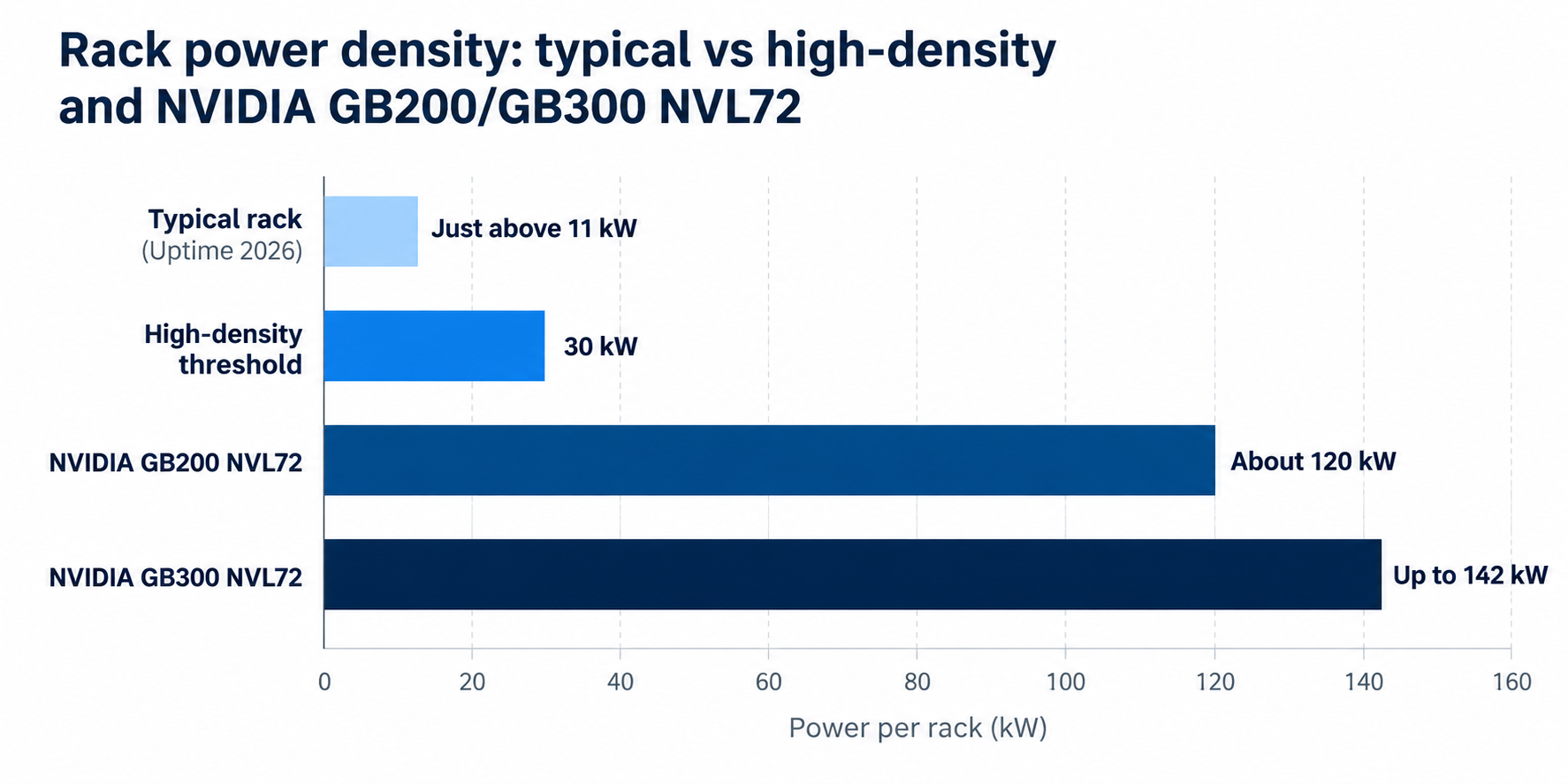
Kilowatts per rack measure how much electrical power a populated rack consumes and therefore how much heat the facility must remove. Direct-to-chip liquid cooling carries coolant through pipes to cold plates attached to processors, so room air no longer has to remove the full heat load. Rear-door heat exchangers offer another approach, transferring heat as air leaves the rack.
High density does not automatically require a hyperscale data centre. Some colocation facilities support dense GPU infrastructure and liquid cooling; others were designed around much lower loads. The decision rests on the capacity available at the specific site. JLL estimated that AI represented about 25% of data centre workloads in 2025 and projects that the share could reach 50% by 2030, so power and cooling headroom need to cover the next hardware cycle as well as the first installation.
In order to choose the right facility for your workload, ask a prospective provider three questions:
- What is the maximum supported kW per rack for the planned configuration? Confirm both continuous capacity and any limits on the surrounding row or hall.
- Which cooling method is available? Establish whether the site supports air cooling, rear-door heat exchangers or direct-to-chip liquid cooling for that rack design.
- How much power headroom remains for growth? Contracted capacity and a credible expansion path matter if the next generation of hardware draws more power.
What is the real cost of getting cloud vs colocation wrong?
The wrong placement either leaves expensive capacity idle or turns variable service charges into a recurring cost problem. The warning signs usually appear before a contract ends or hardware reaches replacement age.
| Model | What can go wrong | Early warning sign |
|---|---|---|
| Own data centre | Oversized buildings, power and hardware tie up capital if demand falls. As an order of magnitude, JLL put 2025 shell-and-core construction at $10.7 million per MW. | Forecast demand repeatedly falls below reserved capacity and the utilisation target is missed. |
| Colocation | Insufficient rack density, cooling or contracted power restricts expansion; a long contract also becomes costly if the workload changes. Hardware refreshes, spare parts and in-house skills remain your responsibility. | New equipment exceeds the rack power envelope, or growth consumes the contracted headroom earlier than planned. |
| Hyperscale cloud | Idle resources, data egress and services that are difficult to replace increase the bill as usage grows. | Unit cost per transaction rises, committed discounts hide unused capacity, or migration tests expose proprietary dependencies. |
How locked in are you to a hyperscale cloud provider?
Moving data out of a cloud platform often incurs egress fees, which the UK’s Competition and Markets Authority identified as a commercial barrier to switching providers and using multi-cloud. Its July 2025 investigation reported that AWS and Microsoft each held 30% to 40% of the UK infrastructure-as-a-service market in 2024, while Google held 5% to 10%.
In March 2026, the CMA reported that Amazon and Microsoft had taken material steps to lower egress fees for UK customers. Within the EU, the Data Act removes switching charges, including data egress charges, from 12 January 2027, but the rule does not apply to the UK. Before choosing a new environment, calculate egress as a share of the last 12 months of cloud bills and test the cost and time required to move data. Private connections between colocation and cloud also change the network and egress calculation, as the hybrid infrastructure section below shows.
Hybrid infrastructure: combining hyperscale cloud and colocation
Hybrid architecture places workloads in private infrastructure and public cloud according to their technical and commercial needs. Flexera reported in 2026 that 73% of organisations operated hybrid environments, while Uptime Institute estimates that 48% of workloads will run in third-party facilities by 2028.
| Workload | Typical placement | Why |
|---|---|---|
| AI training and steady GPU work | Colocation or dedicated private infrastructure | Sustained utilisation supports owned hardware economics, provided the site meets power and cooling requirements. |
| Regulated or location-bound data | Colocation or private cloud in a defined jurisdiction | The physical location and operational controls are set by contract and architecture. |
| Stable core databases and storage | Colocation or private cloud | Predictable demand suits reserved capacity and dedicated performance. |
| Bursty or seasonal web traffic | Hyperscale cloud | Resources scale with demand without leaving peak capacity idle all year. |
| New products and experiments | Hyperscale cloud | Teams provision resources quickly while demand and architecture remain uncertain. |
| Disaster recovery | A separate colocation site, public cloud or both | The recovery copy stays outside the primary failure domain and matches the required recovery plan. |
In practice, organisations often keep stable workloads in colocation and draw on cloud resources during traffic peaks. New products frequently start in cloud and move once demand becomes predictable. Some architectures keep data in colocation while cloud services process it, which makes latency and data-transfer costs important factors in the design.
A cloud on-ramp is a private, direct connection from a data centre to a public cloud, bypassing the public internet. M247 Cloud Connect provides private connections to AWS, Microsoft Azure and Google Cloud, allowing colocated infrastructure and public-cloud resources to communicate through a defined network path.
How to choose between hyperscale cloud and colocation
Apply the decision to each workload rather than treating the infrastructure estate as one block. These seven questions expose the main cost, control and capacity constraints:
- How stable was demand over the past 12 months? Predictable, sustained use supports colocation and owned hardware; sharp or uncertain variation favours cloud consumption.
- How much capital do you want tied up in infrastructure? Colocation avoids building the facility but leaves the hardware purchase with you, while cloud converts more of the stack into operating expenditure.
- Do you want to operate a data centre or focus on applications? Colocation transfers power, cooling, physical security and facility operations to the provider; public cloud also transfers ownership of the servers.
- What power density will the workload require in three years? Compare the hardware roadmap with the facility's rack limit, cooling method and available expansion power.
- Do regulation or customer contracts dictate where data resides? Identify the required jurisdiction, audit evidence and controls before selecting a site or cloud region.
- What share of the cloud bill is egress today? Review 12 months of invoices and model data movement under the proposed design, including any private connections.
- Does the team have the people to manage hardware, or a plan to hire them? Colocation removes facility work, but server configuration, maintenance, spares and refresh cycles still require ownership.
The answer may differ for a database, an AI cluster and a customer-facing application. Placement should therefore be reviewed workload by workload, with measured demand and a three-year capacity view.
Hyperscale data centres are built by the limited number of companies whose business depends on supplying compute or internet services at global scale. For other organisations, the decision lies between hyperscale cloud, colocation and a hybrid combination, chosen for each workload according to demand, control, cost and power requirements. To examine how dedicated infrastructure and private cloud connectivity could support that design, you can discuss the rack and power options in M247 colocation with the M247 Global team.