

Key info in this article
- Start with the workload, not the bandwidth model. For a dedicated server, the first question is what applications will run on it and how they will use the network.
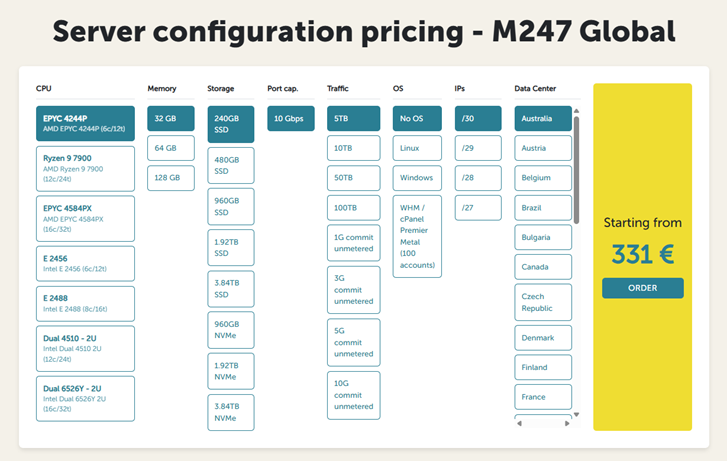
- Metered = pay for traffic volume. This model is suitable for moderate, predictable traffic, with options such as 5, 10, 50 or 100 TB per month.
- Unmetered = pay for connection capacity. You choose a port speed—1, 3, 5 or 10 Gbps—with no monthly traffic quota, making costs more predictable for high or variable traffic.
- Port speed ≠ traffic volume. A 10 Gbps port does not automatically mean unmetered traffic. The same 10 Gbps port can come with a 5, 10, 50 or 100 TB monthly traffic allowance.
When choosing a dedicated server, businesses tend to focus first on CPU, RAM and storage. But for many workloads, the network configuration can be just as important - and it can have a direct impact on both performance and monthly costs.
One of the key decisions is whether to choose a metered or unmetered bandwidth plan, M247 Global offerign both these options for dedicated server solutions.
The difference is straightforward: metered bandwidth is priced around the amount of data transferred, while unmetered bandwidth is priced around the capacity of the network connection. In other words, with a metered plan you buy a certain amount of traffic, while with an unmetered plan you buy a connection speed and can transfer as much data as that connection allows.
But which model makes more sense for your business? The answer depends less on the server itself and more on how your applications use the network.
Metered bandwidth: pay for the traffic you expect to use
With a metered plan, the bandwidth allowance is expressed as a volume of data transferred during a month - for example, 5 TB, 10 TB, 50 TB or 100 TB. This model can be attractive when traffic is relatively predictable and the expected monthly volume is well understood.
A company running an internal application, a corporate website or a business application with moderate traffic may not need an unmetered connection. If the expected data transfer remains comfortably within the selected allowance, a metered configuration can provide an efficient way to control infrastructure costs.
The main consideration is traffic variability. If usage suddenly increases - because of a successful campaign, a large file distribution operation or an unexpected spike in visitors - the business needs to know what happens after the included allowance is reached. Depending on the provider and contract, additional traffic can generate extra charges or other restrictions.
Metered bandwidth can make sense for:
- Corporate websites and portals with relatively predictable traffic
- Business applications where data transfer is moderate compared with compute requirements
- Development and test environments
- Databases and application servers where most traffic remains within controlled environments
- Backup servers where transfer volumes and backup windows can be planned
- Projects in an early stage, where actual traffic requirements are still relatively low and measurable
The advantage is simple: you can align the bandwidth package with the amount of traffic you actually expect to generate.
Unmetered bandwidth: pay for connection capacity, not data volume
Unmetered bandwidth takes a different approach. Instead of selecting a monthly traffic allowance, you select a port speed, such as 1 Gbps, 3 Gbps, 5 Gbps or 10 Gbps, and the traffic is not capped by a monthly data quota. The practical limit is therefore the capacity of the selected connection.
This makes the monthly cost much easier to predict when traffic is high or difficult to forecast.
For example, consider the difference between:
- 10 Gbps port + 50 TB traffic
- 10 Gbps port + 10 Gbps unmetered
and
The first configuration gives you a 10 Gbps-capable port but a defined monthly traffic allowance. The second gives you a 10 Gbps connection without a monthly traffic ceiling.
This distinction becomes increasingly important as the volume of data moving through a server grows.
When does unmetered make sense?
Unmetered bandwidth is particularly relevant when traffic is either consistently high or difficult to predict.
Video and media delivery
Video streaming can generate substantial amounts of outbound traffic. A relatively small number of users consuming high-resolution video can quickly translate into terabytes of data transfer.
For these workloads, an unmetered connection can make network costs more predictable and remove the need to constantly monitor whether the traffic allowance is approaching its limit.
High-traffic websites and e-commerce
An online store, media platform or high-traffic website may experience significant variations in traffic.
A marketing campaign, seasonal promotion or unexpected increase in popularity can change traffic volumes rapidly. An unmetered configuration provides greater freedom to accommodate that growth without calculating every additional terabyte.
Game servers
Online gaming environments can generate continuous network traffic and need consistent connectivity.
For game-server operators, bandwidth requirements may also change as the number of players changes. An unmetered connection can therefore be useful when the objective is to maintain predictable network economics while accommodating changing demand.
Large file distribution
Businesses distributing software packages, media files, datasets, backups or other large files can generate significant outbound traffic even when the number of users is relatively small.
Here, the volume of data transferred can become much more important than the computing resources used by the server itself.
Backup and replication
A dedicated server used for backup, disaster recovery or data replication may transfer large amounts of data periodically rather than continuously.
For these environments, the question is not simply "How much traffic do we normally use?" but also "What happens when we need to move a very large amount of data quickly?"
An unmetered connection can provide more predictable economics for these high-volume transfers.
Growing digital businesses
For a growing business, predicting traffic six or twelve months ahead can be difficult.
An infrastructure configuration that works today may become restrictive as the customer base grows. Unmetered bandwidth can provide additional flexibility because increasing the amount of data transferred does not automatically mean increasing the traffic allowance.
Don't confuse port speed with traffic volume
There is another important distinction when comparing dedicated server offers. A 10 Gbps port does not automatically mean 10 Gbps of unmetered traffic. A server can have a 10 Gbps network port while being configured with a 5 TB, 10 TB, 50 TB or 100 TB monthly traffic allowance.
Alternatively, it can have the same 10 Gbps port combined with a 10 Gbps unmetered bandwidth option.
The first determines the maximum network capacity of the connection. The second combines that capacity with a commercial model that does not impose a monthly data-transfer ceiling.
This is why comparing dedicated server offers only by looking at the headline port speed can be misleading.
Which model should you choose?
There is no universal answer. The right choice depends on the relationship between traffic volume, predictability and business requirements.
|
Requirement |
Metered |
Unmetered |
|
Predictable, moderate traffic |
✓ |
|
|
Need to closely control initial costs |
✓ |
|
|
Traffic varies significantly |
✓ |
|
|
High-volume data transfer |
✓ |
|
|
Video / media delivery |
✓ |
|
|
Large file distribution |
✓ |
|
|
Game servers |
✓ |
|
|
Rapidly growing applications |
✓ |
|
|
Need predictable bandwidth costs |
✓ |
✓ |
|
Traffic can be accurately forecast |
✓ |
|
|
Traffic is difficult to forecast |
✓ |
The important point is that unmetered is not automatically better, just as metered is not automatically cheaper. The economics depend on how much traffic the server actually generates and how valuable cost predictability is for the business.
Dedicated servers configured around your workload
The best dedicated server configuration is not necessarily the one with the highest CPU, the most RAM or the largest network port. It is the one that provides the resources your workload actually needs - without paying for capacity that remains unused or creating restrictions that can affect the business later.
That is why the choice between metered and unmetered bandwidth should be made alongside the other server specifications.
With M247 Global, dedicated server configurations can be built around different requirements, from metered traffic options of 5 TB, 10 TB, 50 TB and 100 TB to 1 Gbps, 3 Gbps, 5 Gbps and 10 Gbps unmetered options. The objective is simple: give businesses the flexibility to choose the network model that matches their workload, keep infrastructure costs predictable and have the capacity needed to support their business objectives.
Whether your priority is controlling costs for a predictable workload or supporting large and variable volumes of data, M247 Global offers dedicated server solutions for different business scenarios - so you can choose the infrastructure that fits your needs rather than adapting your business to the limitations of your infrastructure.