

Water consumption has become one of the most scrutinised sustainability metrics in the data center industry, driven largely by public concern over the resource footprint of AI training and inference workloads. Headlines about data centers "drinking" millions of liters of water have shaped public perception — but the technical reality is more nuanced, and increasingly favorable, as cooling technology evolves.
This article looks at the metric the industry actually uses to measure water efficiency — Water Usage Effectiveness (WUE) — how it has evolved as cooling technology has advanced, and how data center water consumption compares to other major water-using industries and sectors.
Important to note: M247 Global places particular emphasis on energy efficiency across its data centers, investing consistently in next-generation cooling technologies as well as in sourcing power from renewable energy.
What Is WUE, and How Has It Evolved?
WUE (Water Usage Effectiveness) is the standard industry metric for data center water efficiency, expressed in liters of water consumed per kilowatt-hour (L/kWh) of IT energy delivered. It was introduced by The Green Grid as a companion metric to PUE (Power Usage Effectiveness), and it captures how much water a facility uses — mostly for cooling — relative to the compute it actually delivers.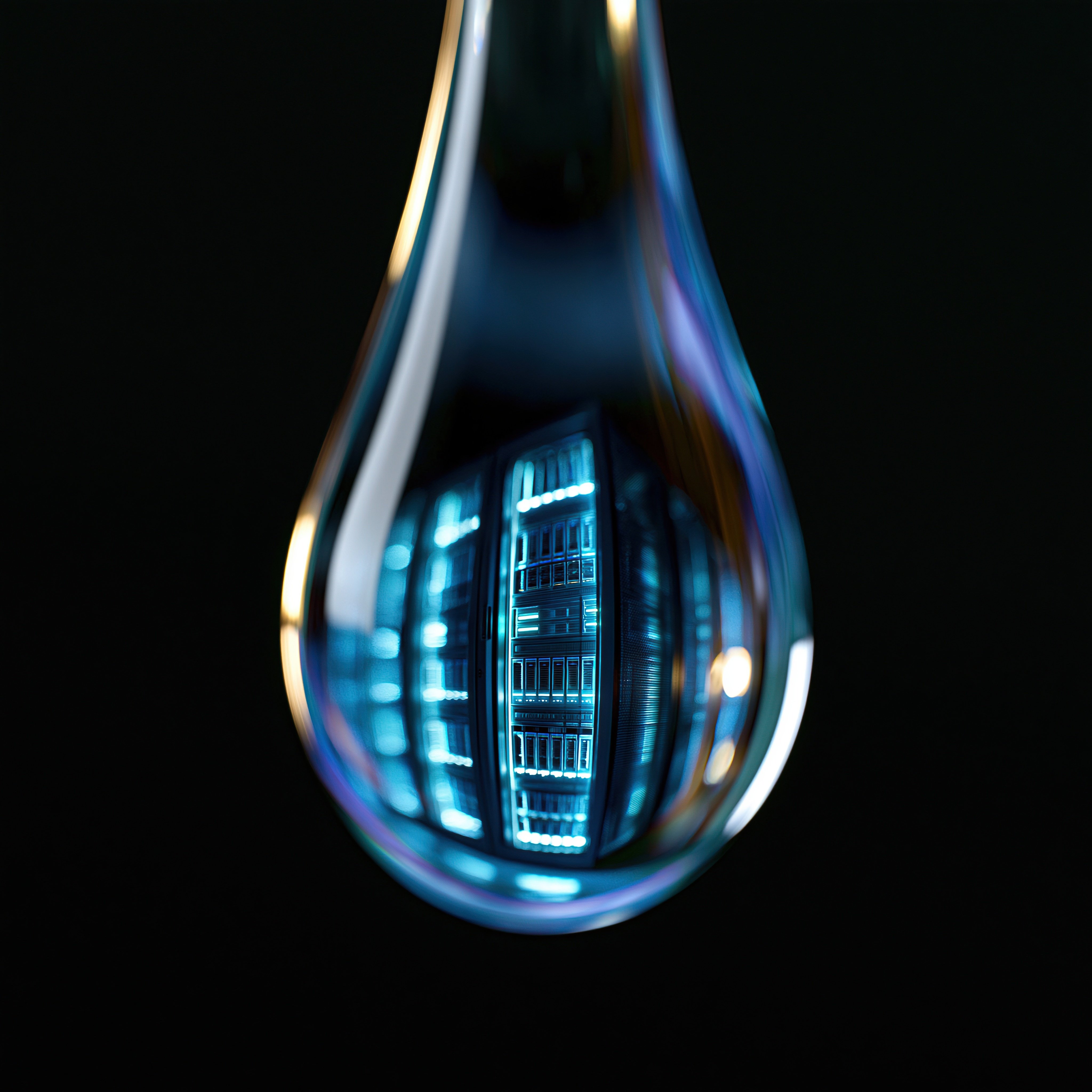 A lower WUE means less water is consumed to cool the same amount of computing power. The metric has become central to sustainability reporting, and hyperscale operators now publish it annually.
The technology driving WUE down
Evaporative cooling (the traditional baseline). Most legacy data centers rely on cooling towers, where water is evaporated into the air to reject heat. This is effective and relatively cheap, but water-intensive. The industry-average WUE for evaporative systems has consistently been cited around 1.8–1.9 L/kWh, according to the Environmental and Energy Study Institute (EESI) and confirmed independently by Badger Meter, with some less efficient facilities exceeding 2 L/kWh.
Adiabatic and air-assisted cooling. A step up in efficiency, these systems use evaporation more selectively — only during peak heat load — bringing WUE down to roughly 0.1–0.4 L/kWh, per benchmarking data compiled by data center intelligence & marketing agency Kova Stack.
Closed-loop liquid cooling. Instead of evaporating water into the atmosphere, closed-loop systems recirculate the same coolant continuously through sealed pipes, topping up only occasionally to offset minor losses. Because water isn't "burned off," on-site consumption drops dramatically. Several major hyperscale operators have adopted "zero-water evaporation" closed-loop designs specifically to eliminate the water burden of traditional cooling towers, with best-in-class closed-loop installations reporting figures below 0.1 L/kWh (Kova Stack).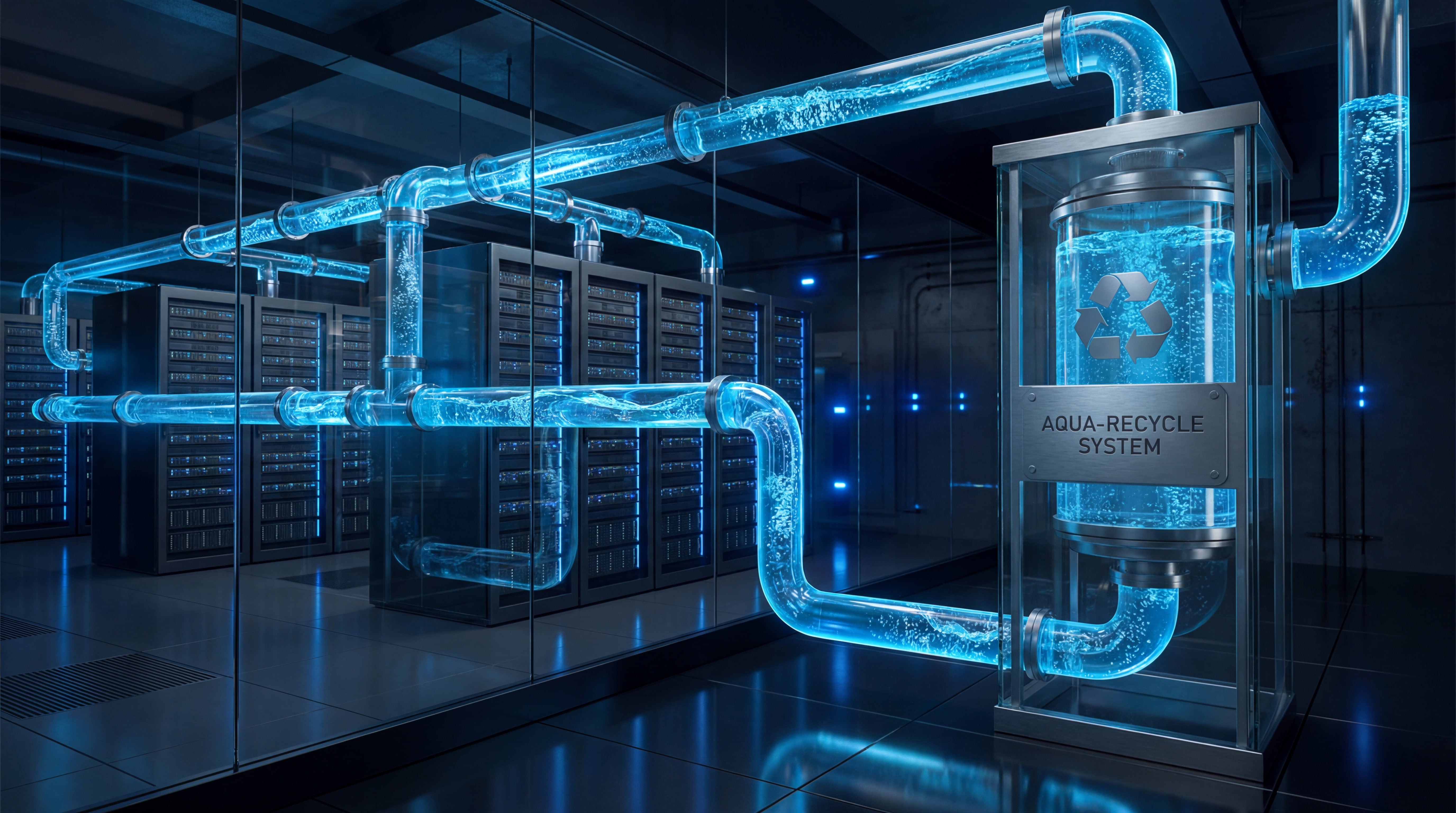 Direct-to-chip cooling. Rather than cooling the entire room, direct-to-chip systems bring coolant into direct contact with the CPU or GPU via cold plates, removing heat at the source. This is becoming the default architecture for AI training clusters, where rack densities of 40kW to well over 100kW make air cooling physically insufficient. Direct-to-chip is frequently paired with a closed-loop external circuit, combining thermal performance with minimal water draw.
Immersion cooling. The most advanced approach submerges entire servers in a dielectric (non-conductive) fluid that absorbs heat directly. No water is evaporated at all inside the facility. It's worth noting that most closed-loop and immersion systems still rely on some external heat-rejection mechanism — typically a dry cooler or a sealed liquid loop — but because they capture heat so much more directly than room-level air cooling, the external water burden is a fraction of what a traditional evaporative tower requires (arXiv, "AI Data Centers and the Water Use Feedback Loop").
The overall trend
Benchmarking across 15 U.S. climate zones puts hyperscale-class facility WUE in the range of 0.09 to 1.80 L/kWh, against 1.99 to 4.00 L/kWh for traditional evaporative systems — a roughly tenfold difference on average between older and newer cooling architectures (arXiv, "AI Data Centers and the Water Use Feedback Loop"). The direction of travel across the industry is consistent: as facilities move from evaporative, to adiabatic, to closed-loop and direct-to-chip designs, water consumption per unit of compute keeps falling — even as compute density rises.
Data Centers in Context — How Much Water Do They Really Represent?
To understand whether data center water use is significant, it helps to place it against the broader global water picture.
The global macro split
Worldwide freshwater use breaks down into three broad categories: agriculture accounts for roughly 70% of global use, industry and energy account for about 20%, and municipal/domestic use makes up the remaining 10% (Worldometers). Agriculture, by a wide margin, remains the single largest driver of global freshwater withdrawal.
Where data centers sit within the industrial 20%
Within the industrial and energy share tracked by bodies such as the European Environment Agency, the breakdown of industrial water withdrawal looks roughly as follows:
- Thermoelectric / electricity generation cooling: ~33% of industrial-associated abstraction — cooling for nuclear, coal, and gas power plants.
- Manufacturing (chemicals, metals, paper, food processing): ~14–20%.
- Mining and quarrying: ~4% — ore processing and mineral extraction.
- Construction: ~3% — cement, lumber, and material processing.
- Textiles: a smaller share of total withdrawal but an outsized per-product footprint — roughly 200 litres of water per kilogram of fabric produced.
Data centers, including AI-focused facilities, are a comparatively small and fast-improving slice of this picture. At the national level, all U.S. data centers combined consumed an estimated 449 million gallons of water per day (roughly 1.7 billion litres) as of 2021 — approximately 0.3–0.4% of total U.S. water withdrawals, acoording to Florida Water and Pollution Control Operators Association.
Comparable water footprints from other sectors
A few concrete reference points help calibrate the scale:
- Semiconductor fabrication — the manufacturing step that produces the chips inside every electronic device — is itself water-intensive: a single fab can use between 2 and 10 million gallons of ultrapure water per day.
- Brewing — producing a single litre of beer can require up to 25 litres of water.
- A standard 18-hole golf course irrigates roughly 1.2 million litres of water per day, rising above 3.7 million litres per day in arid climates.
- A natural-grass football pitch consumes an average of around 100,000 litres per day for irrigation alone.
Set against these figures, a modern data center running closed-loop or direct-to-chip cooling — with a WUE well under 0.5 L/kWh — represents a modest and shrinking water footprint relative to agriculture, thermoelectric power generation, manufacturing, and even everyday recreational infrastructure.
Energy matters as much as cooling
It's also worth noting that a data center's indirect water footprint — the water consumed to generate the electricity it draws — can rival or exceed its direct on-site cooling use, particularly where power comes from thermoelectric generation that requires water for turbine cooling. This makes the source of electricity, not just the cooling architecture, a material factor in a facility's total water footprint.
M247 Global's Approach
Sustainability is a core design consideration across M247 Global's infrastructure. The company invests in modern, water-efficient cooling technologies as part of its data center strategy, and sources a growing share of its electricity from renewable and alternative energy, reducing both the direct and indirect water footprint of its operations. As demand for AI-ready capacity grows, M247 Global continues to prioritise infrastructure that is efficient by design — not efficient as an afterthought.