
-1.jpeg?width=734&name=WhatsApp%20Image%202026-09-30%20at%2009.44.57%20(6)-1.jpeg)
On September 29, 2026, Bucharest hosted the 11th edition of RONOG - Romanian Network Operators Group. The conference, organized at the Radisson Blu Hotel Bucharest with the support of InterLAN-IX, gathered several hundred participants: network and telecom operators, Internet service providers, cybersecurity specialists, representatives of technology companies, and public institutions.
The agenda covered network security and cyberattacks, data traffic growth, fiber optic infrastructure, data center technologies, traffic routing, direct network interconnection, and the evolution of European Internet Exchanges. Artificial intelligence and network automation were also topics addressed at the event. The day concluded with the RONOG 11 Networking Party, where discussions continued in an informal setting.
The RONOG format remains unchanged: technical sessions, concrete industry experiences, and commercial presentations discouraged. That is precisely why it was a conference where the people who build and operate the Internet's infrastructure interacted face-to-face.
M247 Global, Present as Gold Partner
M247 Global participated in RONOG 11 as a Gold Partner. For the company, this was not an isolated appearance, but one in a series of consecutive participations through which M247 Global has become part of the RONOG community.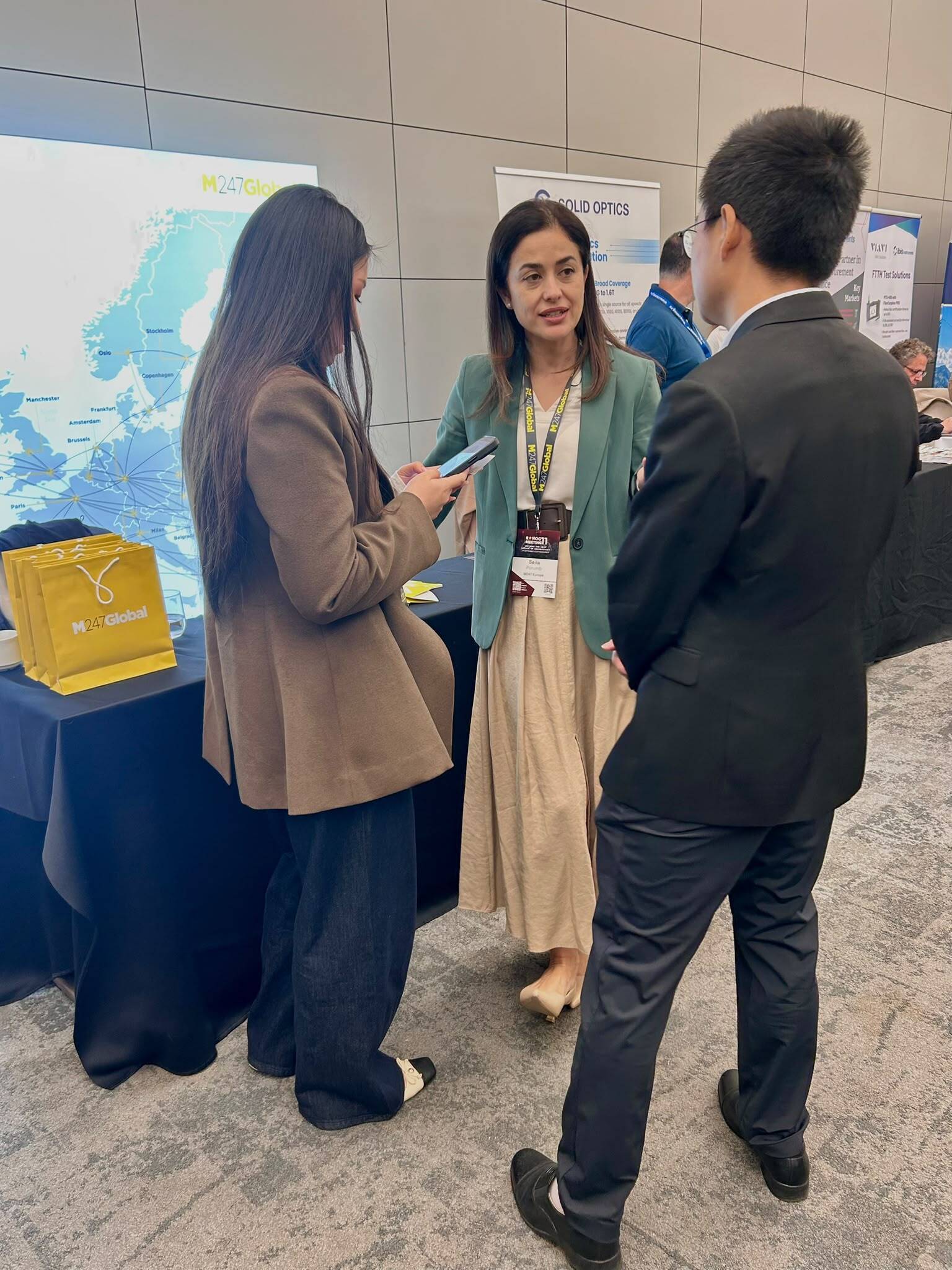 At the sponsors' booth, the business development management team presented M247 Global's core services: cloud, dedicated servers, connectivity, and DDoS protection. Participants were able to discuss configurations, network requirements, and concrete migration and security scenarios with the experts.
On Stage: “Out of the Hypervisor Trap”
The moment on stage belonged to Alin Ștefănescu, Global Network Architect at M247 Global, with the presentation “Out of the Hypervisor Trap,” which highlighted how M247 Global rebuilt its cloud on OpenStack and significantly simplified its usability.
Alin Ștefănescu started from a change that operators are already feeling in their budgets. In the proprietary virtualization solutions market, product portfolios compressed from 168 SKUs down to 4 packages, perpetual licenses disappeared starting in 2024, and renewal price hikes reached—according to presented data—between 100% and 1000%, compared to the 10–20% annual increase previously considered typical. The conclusion: for an end user, this is a painful budget line item, but for a hosting provider, it is an existential problem, because you cannot build a solid business if prices are so volatile. Along with costs, there is another stake. Alin’s presentation described the “dependency triad”: hypervisor lock-in, operational lock-in (every runbook and every automation tied to a single API), and commercial lock-in (no perpetual license and no negotiation leverage). The question proposed to the audience was simple: if your Cloud provider tripled the price tomorrow, in how many months could you migrate?
M247 Global’s answer was OpenStack. The reasons: open governance, no per-core licensing fee, and the exit from the ecosystem built directly into the design. The market validates the choice: over 55 million cores in production worldwide in 2025, an estimated ~4x growth in deployments by 2029, and over 80% of vendors in the ecosystem facing exoduses from VMware. A strategic advantage: M247 Global’s infrastructure spans over 55 data centers/Points of Presence across 28 countries and 5 regions, with a 100% open-source control plane and zero per-core licensing fees.
The OpenStack Problem: The First Thirty Minutes
Alin Ștefănescu also brought up a weakness of the platform: OpenStack’s problem is not about capabilities, but about the first thirty minutes. Horizon is an operator console and does not offer a simple experience for clients. A client who just wants a virtual machine faces a level of complexity that offers no benefit to them.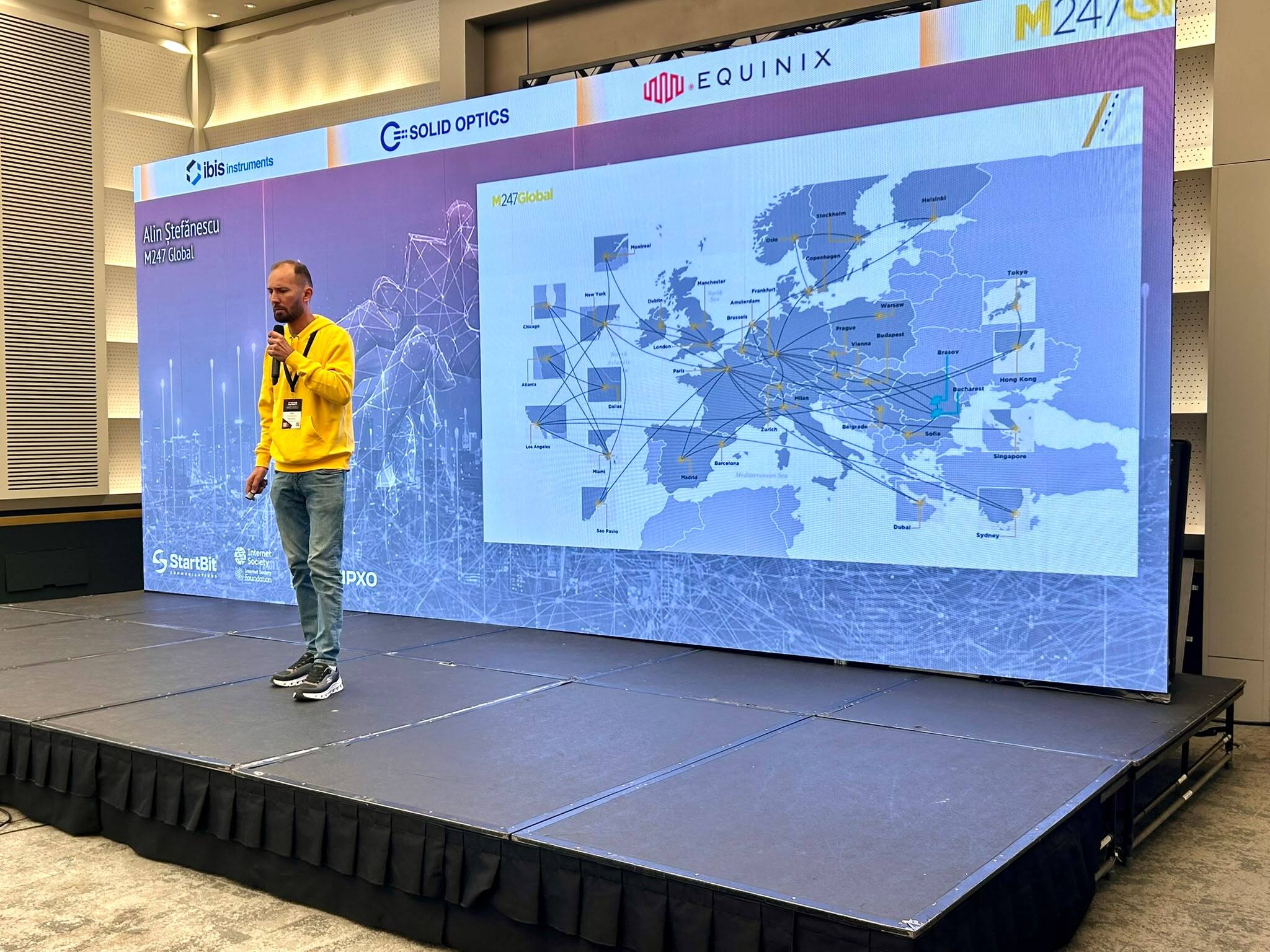 M247 Global’s solution was a “front door”: a client portal that hides complexity without sacrificing power. For non-specialists, the workflow is simple: choose the country, size, and image, then deploy. Resources are configured in clear language (CPU, RAM, disk), backups and snapshots are single buttons, and the bill is a single itemized invoice in Euros. For engineers, the portal offers native OpenStack API, Terraform, Ansible, CLI and SDKs, cloud-init, custom images, RBAC, projects, quotas, API keys, and audit logs. Both worlds work on the same infrastructure.
This is how Alin Ștefănescu summarized the core idea: “We have two types of consumers: basic users who set up simple services, and power users who can leverage automated tools for high-complexity services. OpenStack helps us integrate these two worlds.”
Under the hood, the architecture is conventional yet powerful: Keystone, Nova, Cinder, Glance, and Octavia on the control plane, Ceph and S3-compatible object storage, networking with Cisco, Juniper, and Fortinet equipment, AMD and Intel compute in Tier 3 data centers, with 99.95% SLA and 24/7 NOC, plus managed DDoS protection. The message: standard components, each replaceable, which together bring added value.
Portability and Sovereignty
Another key point of the presentation was portability. Moving a workload between sites should be “a regular Tuesday, not a project”: snapshot, replication over our own backbone (not the public Internet), rehydration, and cut-over, with rollback possible if issues arise. No re-architecture, no egress fees designed to discourage you. The formats are open, so moving can even mean, if needed, leaving M247 Global entirely.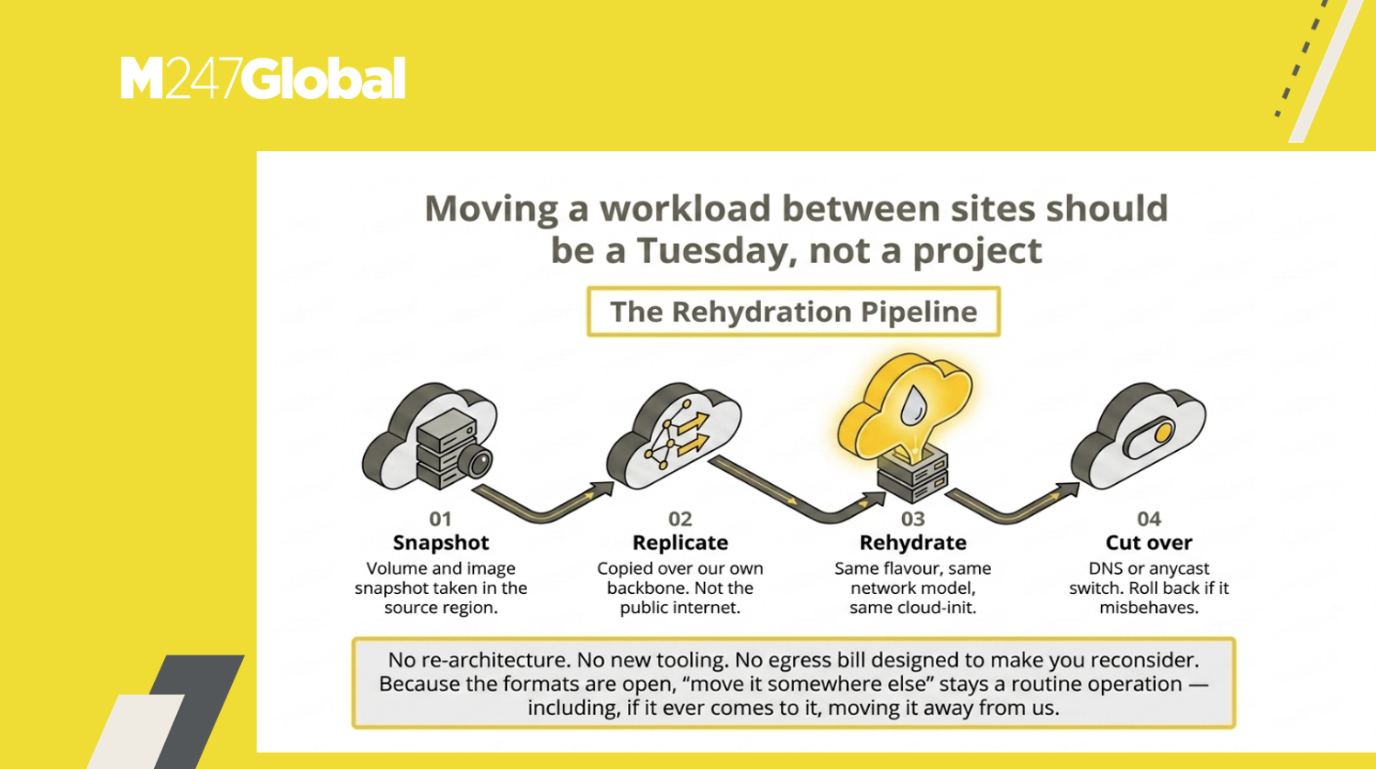 In this logic, open source becomes a sovereignty control, not a licensing preference: EU entity and contract, EU data centers, control plane auditability, no hidden dependencies, and a real exit path. In M247 Global’s case—operating two data centers in Romania (Bucharest and Brașov)—a workload can stay in the country and, if necessary, failover to Vienna, Amsterdam, or Manchester using the exact same API and portal.
For those looking to migrate, the process is structured in four phases: assessment (inventory, dependency mapping, an honest list of “what we aren’t moving yet”), a pilot on the lowest-risk workload, wave migration, and continuous optimization. The source environment remains active until each wave is validated, and hybrid setups are a valid long-term destination.
The presentation ended with three takeaways: measure dependency in months (how many months would a migration to another provider take), budget for OpenStack's "UX tax" or use a ready-made front door, and portability must work both ways—including when you leave a provider.
Booth Offers Remain Valid for 30 Days
If you stopped by the M247 Global booth or watched the presentation and still have questions, the service offers and discounts presented at RONOG 11 remain valid for another 30 days for conference participants. We encourage you to write to us here for more details about cloud, dedicated servers, connectivity, or DDoS protection, and our team will prepare a configuration tailored to your project.
We thank the RONOG organizers and InterLAN-IX for another successful edition and the community for today’s discussions. See you at the next one!